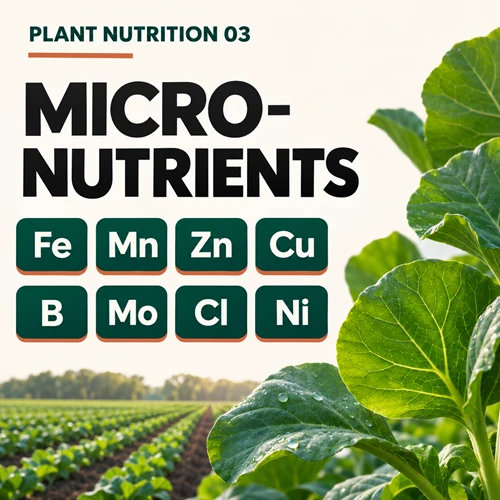
Essential Plant Nutrients and Their Roles in Crop Growth Part 3: How to Identify and Correct Micronutrient Deficiencies
Iron, manganese, zinc, copper, boron, molybdenum, chlorine and nickel are essential micronutrients. Crops need relatively small amounts, but a shortage can still limit growth. Excesses can also cause damage. Before choosing a trace element product, establish which nutrient is likely to be limiting and why.
Iron and manganese affect leaf color in different ways
Iron participates in electron transfer and is needed for normal chlorophyll formation. Deficiency often starts on young leaves, with greener veins and yellow tissue between them; severe symptoms may approach a pale yellow or whitish appearance. In calcareous or alkaline soils, total iron can be plentiful while plant available iron remains inadequate. Repeated applications of an ordinary iron salt may therefore give disappointing results.
Manganese supports the water splitting step of photosynthesis and several enzyme reactions. Deficiency may also produce interveinal yellowing, sometimes with fine speckling, depending on the crop. Visual symptoms alone may not distinguish it from iron deficiency or other disorders. High pH can reduce availability, while strongly acidic conditions can create manganese toxicity.

Zinc supports new growth and copper supports enzyme activity
Zinc is involved in enzyme systems and auxin metabolism. Possible deficiency symptoms include small leaves, shortened internodes, rosetting in some fruit crops and pale bands in maize leaves. Virus damage and herbicide injury can resemble some of these signs. Review zinc supply particularly where high pH, excessive phosphorus or restricted roots may limit uptake.
Copper supports oxidation and reduction reactions and lignin formation. A shortage can affect shoot development and reproduction, but there is no single dependable visual sign for every crop. Fields with a long history of copper based crop protection treatments may already have accumulated copper. Copper fertilizers and copper based plant protection products have different purposes and are not interchangeable.
Boron supports reproduction but does not solve every fruit set problem
Boron contributes to cell wall formation, pollen germination and pollen tube growth. Depending on the crop, deficiency may damage growing points, distort young leaves or cause internal disorders in harvested organs. Poor fruit set can also result from temperature stress, inadequate pollination or moisture problems. Flower drop alone is not enough evidence to prescribe boron.
Boron has a relatively narrow margin between adequate and excessive supply. Count contributions from soil applications, fertigation, foliar sprays and blended products together. Do not transfer a dilution rate from one product to another or increase the concentration simply to seek a faster response. Boron mobility also differs between crops, so one spray program will not suit every orchard or vegetable crop.

Molybdenum helps nitrogen use while chlorine and nickel need little supplementation
Molybdenum is required for nitrate reduction, and the nitrogen fixing system of legume root nodules also depends on it. Deficiency can resemble nitrogen deficiency and deserves attention in acidic soils. However, weak nodulation may also involve unsuitable soil pH, poor root conditions or ineffective rhizobia. Molybdenum alone will not correct every nodulation problem.
Chlorine, taken up as chloride, contributes to osmotic regulation, ion balance and photosynthesis. Nickel is needed for urease activity in urea metabolism. Both are essential, but deficiencies are uncommon in many conventional production systems. They should not automatically be added to every feeding program. Chloride containing fertilizers must fit crop sensitivity, irrigation water quality and soil salinity; suspected nickel deficiency needs professional testing rather than routine dosing.
Have micronutrient deficiency problem?
Separate low supply from poor availability
A soil with inadequate reserves may benefit from root zone supplementation. Where pH, cold conditions or root damage restrict uptake, simply increasing soil applications may be inefficient. Foliar feeding can offer targeted support under suitable conditions, but it does not replace root zone management. For chelated products, check the actual chelating agent, its effective pH range, nutrient content and intended application method.
A single nutrient product allows precise correction of a confirmed shortage. A mixed micronutrient product is convenient, but its fixed proportions may not match the field. Review all inputs for overlapping nutrients, especially boron and copper. Follow the label for foliar use, avoid hot conditions and strong sunlight, and test on a small area first.
Use the whole series to guide a fertilizer decision
Record symptom position and distribution, then check roots, moisture, pH and salinity. Soil tests describe nutrient supply conditions; tissue tests indicate what the crop has taken up. Interpret them together with crop stage and sampling guidance. Silicon and other beneficial elements may help some crops, but they do not replace the essential nutrients.
Balanced nutrition does not mean applying every element at every feeding. A useful program explains what is limiting growth, how much of that nutrient the selected product adds, and how crop response or follow up testing will be used to judge the result.
Series links:
Part 1: How Nitrogen Phosphorus and Potassium Affect Crop Growth
Part 2: How Calcium Magnesium and Sulfur Support Healthy Crops
Further reading:
Essential plant nutrients
https://nevegetable.org/Cultural-Practices/plant-nutrients
Soils and plant nutrients
https://content.ces.ncsu.edu/extension-gardener-handbook/1-soils-and-plant-nutrients
Soils, plant nutrition and nutrient management
https://extension.missouri.edu/publications/mg4
Micronutrients in soils and plant nutrition
https://cto.extension.msstate.edu/publications/micronutrients-mississippi-soils-and-plant-nutrition
To discuss a formulation, request a sample or learn more about OEM services, contact us: