What Tests Are Needed for a New Water-Soluble Fertilizer Sample?

A newly prepared fertilizer sample may look ready to ship, but the appearance alone shows little about its behavior in storage or in the field. So, before shipment, it should pass practical checks covering composition, solubility, stability and use conditions.
Our development path is straightforward: confirm the customer's requirements, design the formula, prepare the sample, complete the tests, review the results and retain a reference sample. Problems can be found while the formula is still easy to adjust.
The following is what we do before the final sample confirmation:
1. Record the Sample Before Testing
Every sample needs a unique number linked to its date, physical form, formula version, raw-material batches, target analysis, recommended dilution and intended market. This keeps the results traceable and prevents trial formulas from being confused.
2. Routine Tests for a New Water-Soluble Fertilizer Sample
These checks form the basic test program for most new samples.
2.1 Appearance
We first examine color, odor and uniformity, looking for crystals, lumps, foreign matter, separation or sediment. An unusual change may reveal an incorrect raw material, incomplete mixing or an early compatibility problem.
2.2 pH
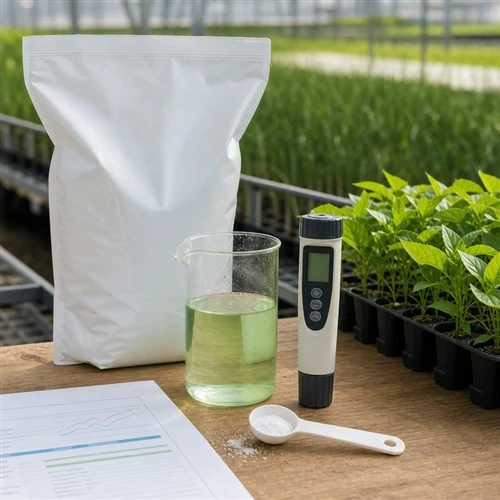
The pH is measured on the original liquid or a specified dilution. It confirms the design range and helps assess stability, packaging compatibility and suitability for the intended application.
2.3 Solubility and Water-Insoluble Matter
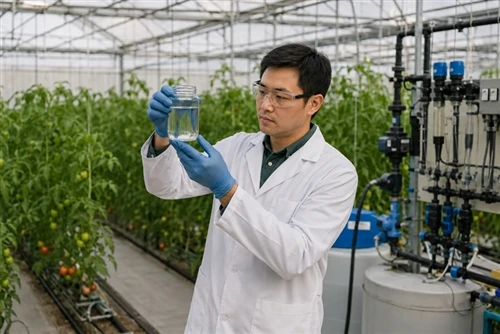
A water-soluble fertilizer should dissolve quickly under defined conditions. We record dissolution time and inspect or filter the solution for residue. Insoluble particles can settle in a tank or block filters, nozzles and drip emitters.
2.4 Dilution Behavior
The sample is diluted to its proposed use concentration and observed for cloudiness, flocculation, color change or sediment. A clear concentrate is not necessarily stable after dilution, especially when local water contains calcium, magnesium or bicarbonates.
2.5 Nutrient Analysis
Nitrogen, phosphorus, potassium and declared secondary nutrients, micronutrients or functional ingredients are tested against the formula target. This checks the proposed specification and label claim. Methods and limits should match the product category and destination market.
2.6 Short-Term Stability
The sample is observed for separation, crystallization, sediment, gas and color change. This is not a shelf-life guarantee, but it often identifies formulas that need adjustment before longer studies begin.
2.7 Packaging Compatibility
A small quantity is stored in the proposed bottle and sealing system. We look for leakage, swelling, corrosion, deformation, deposits and unusual odor. A stable formula can still fail if it reacts with its packaging.
3. Additional Tests for Liquid Water-Soluble Fertilizers
Liquid products need several extra checks because temperature and handling can change their flow and physical stability.
3.1 Density and Viscosity
Density links volume with mass and helps verify filling quantity and nutrient content per unit volume. Viscosity shows whether the product can be pumped, filled, measured and diluted. Both should be measured at a stated temperature.
3.2 High- and Low-Temperature Stability
Samples are exposed to selected warm and cold conditions, then inspected for crystals, sediment, separation or permanent color change. The test conditions should reflect the expected storage and transport route rather than using one temperature program for every market.

3.3 Freeze-Thaw Cycling
Where winter transport is possible, repeated freezing and thawing can reveal instability that a single cold exposure may miss. At room temperature, the sample is checked for recovery, sediment and viscosity changes.
3.4 Vibration Test
Vibration accelerates phase or particle separation and can expose instability quickly. It is a useful screen, not a substitute for real-time or temperature-based storage studies.
3.5 Seal and Gas-Formation Observation
A closed sample is monitored for bottle swelling, pressure, leakage or odor. Gas may point to an unwanted chemical reaction, microbial contamination or unstable raw materials and must be investigated before shipment.
4. Application and Product-Specific Checks
The sample may also be checked with local irrigation water, common fertilizers or crop-protection products in a small jar test. Hard-water behavior, passage through irrigation equipment and a limited plant-safety trial help confirm the dilution. Special formulations require tests relevant to their claims, while export samples may need contaminant or hygiene testing for the destination market.
5. Review, Release and Retention
Results are classified as approved, conditionally approved or rejected. Only approved samples move to customer confirmation or production. Records should cover the formula, raw-material batches, test results, stability observations, shipment and retention period. A changed formula receives a new version and is tested again.
Testing takes time, but it reduces a larger risk: sending a sample that meets its nutrient target but crystallizes, separates, blocks equipment or becomes unsafe at the recommended dilution.