Why Are Plant Leaves Turning Yellow? Causes, Symptoms and Practical Solutions
Yellow leaves are one of the most common problems growers see in the field, greenhouse or orchard. Sometimes the reason is simple: the plant is short of one nutrient. But in many cases, yellowing is not caused by one single factor. It may be connected with roots, soil pH, irrigation water, fertilizer balance, disease pressure or recent stress.
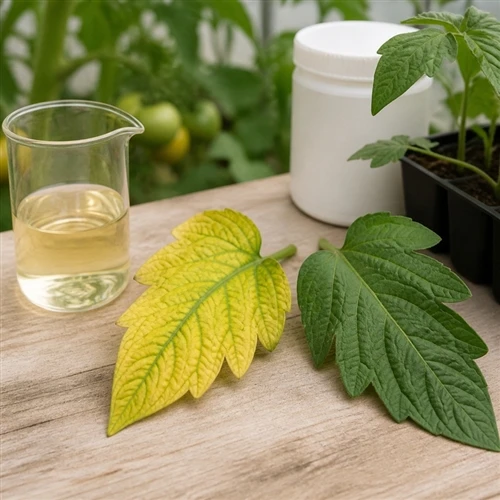
From a plant science point of view, yellowing usually means the leaf is losing chlorophyll or cannot produce enough chlorophyll. Chlorophyll is the green pigment that helps plants capture light and make energy through photosynthesis. When chlorophyll becomes weak, the plant loses its healthy green color and crop growth can slow down.
For growers, the important question is practical: What is causing the yellowing, and what should be done first?

What Plant Yellowing Really Means
Plant yellowing is often called chlorosis. It is a visible signal that the leaf is not working at full strength. A yellow leaf usually has lower photosynthetic ability, which means the plant may produce less energy for root growth, flowering, fruit setting and fruit enlargement.
However, yellow leaves do not always mean the grower should immediately apply more fertilizer. This is a common mistake. If the root system is damaged, the soil is too wet, the pH is unsuitable or the salinity is too high, the plant may not be able to absorb nutrients even when fertilizer is already present.
That is why a good solution starts with diagnosis, not only with dosage.
Common Symptoms Growers Should Observe
The position and pattern of yellowing can give useful clues.
If older lower leaves turn yellow first, the issue may be related to mobile nutrients such as nitrogen or magnesium. The plant can move these nutrients from old leaves to new growth, so the old leaves show symptoms earlier.
If young leaves turn yellow while the veins stay green, the issue may be related to iron, manganese, zinc or root-zone absorption problems. These nutrients are less mobile inside the plant, so new leaves often show symptoms first.
If the leaf edge turns yellow or scorched, the crop may be suffering from potassium deficiency, salt stress, water stress or root injury. If yellowing appears together with spots, wilting, stem lesions or uneven patches across the field, disease or pest damage should also be considered.
The same yellow color can have different causes. The grower should look at leaf age, vein pattern, root condition, soil moisture and recent management changes together.
Talk about your plants chlorosis problem
Main Causes of Plant Yellowing
1. Nutrient Deficiency
Nutrient deficiency is the first cause many growers think of, and it is indeed common. Nitrogen deficiency often causes general pale green or yellow lower leaves. Magnesium deficiency can cause yellowing between veins, usually starting from older leaves. Iron deficiency often causes young leaves to turn yellow while the veins remain green.
Calcium, sulfur, zinc, manganese and boron problems can also affect growth and leaf color, depending on the crop and growth stage.
In practical production, deficiency may happen for two reasons. The first is true shortage: there is not enough nutrient available. The second is induced deficiency: nutrients exist in the soil or solution, but the crop cannot absorb them because of pH, root stress, salinity, cold soil, drought or waterlogging.
2. Poor Root Activity
Roots are the entrance for water and most nutrients. When roots are weak, leaves often become yellow because the upper plant cannot receive enough supply.
Poor root activity may come from overwatering, lack of oxygen in the root zone, compacted soil, root disease, nematode pressure, transplant shock or long-term salt accumulation. In greenhouse production, drip irrigation can also create local wet and dry zones. If the root zone stays too wet for too long, oxygen becomes limited and nutrient uptake slows down.

When yellowing is caused by roots, simply adding more fertilizer may make the problem worse. The first step should be to improve irrigation, drainage, aeration and root recovery.
3. Unsuitable Soil pH and Water Quality
Soil pH affects nutrient availability. In alkaline conditions, iron, manganese and zinc can become difficult for crops to absorb. This is why iron deficiency chlorosis often appears even when iron is present in the soil.
Irrigation water also matters. Hard water, high bicarbonate water or high-salinity water can change the root-zone environment over time. If EC is too high, plants may suffer salt stress and show yellowing, leaf edge burn or weak growth.
For fertigation systems, growers should not only choose a fertilizer formula. They should also check water quality, pH, EC and compatibility with the irrigation method.
4. Unbalanced Fertilization
More fertilizer is not always better. Excessive nitrogen can make plants grow tender and sensitive. Too much of one nutrient may reduce the uptake of another nutrient. For example, excessive potassium can affect magnesium uptake in some conditions, and high phosphorus may influence certain trace elements.
Balanced nutrition means matching the crop stage. Seedlings need root-friendly and gentle nutrition. Vegetative growth needs enough nitrogen and magnesium. Flowering and fruit setting need phosphorus, boron and other support. Fruit enlargement and coloring need potassium, calcium and magnesium.
If the formula does not match the growth stage, the crop may still show yellowing or quality problems even when fertilization is frequent.
5. Disease, Pest Damage and Chemical Stress
Not all yellowing is nutritional. Root diseases, vascular diseases, virus infection, mites, whiteflies, nematodes and other pests can all cause yellow leaves. Herbicide drift, pesticide injury or overly concentrated foliar sprays may also lead to yellowing, leaf curl or burn.
These problems often have extra signs, such as spots, mosaic patterns, uneven field distribution, damaged roots, sticky residue, insects on the leaf back or sudden symptoms after spraying.
If yellowing spreads quickly or appears in patches, growers should inspect for disease and pests before deciding on a fertilizer correction plan.
How to Diagnose Yellowing in a Simple Way
A practical diagnosis can start with five questions.
- First, which leaves turn yellow first: old leaves or young leaves? Old leaves often suggest nitrogen or magnesium movement. Young leaves often suggest iron, manganese, zinc or root-zone uptake issues.
- Second, is the whole leaf yellow, or only the area between veins? Interveinal yellowing is an important sign for several nutrient and pH-related problems.
- Third, what do the roots look like? Healthy roots are usually white or light colored and active. Brown, weak, smelly or damaged roots suggest a root-zone problem.
- Fourth, did the problem appear after a management change? Recent fertilizer changes, pesticide spraying, irrigation changes, cloudy weather, cold stress or transplanting can all trigger symptoms.
- Fifth, is the problem uniform or patchy? Uniform yellowing may be related to nutrition, water quality or environmental stress. Patchy yellowing may suggest disease, pests, irrigation unevenness or soil variation.

Practical Solutions for Growers
The best solution depends on the cause. But in most cases, growers can follow a step-by-step approach.
Start by checking irrigation. Avoid long-term waterlogging and avoid extreme drought. For drip irrigation, make sure water is distributed evenly and the root zone is not staying too wet or too dry.
Then check the root system. If roots are weak, focus on root recovery before applying a strong fertilizer program. Products with amino acids, humic acid, alginic acid, microbial inoculants or plant-based biostimulants may help support root activity and stress recovery when used correctly.
Next, adjust nutrition according to symptoms and crop stage. For general pale lower leaves, a balanced or nitrogen-supporting water-soluble fertilizer may help. For interveinal yellowing, magnesium and trace element support should be considered. For young leaf yellowing under alkaline conditions, chelated trace elements may be more suitable.
Finally, avoid blind high-dose correction. A strong foliar spray or heavy fertigation can burn leaves or increase salt stress. It is better to use a clear diagnosis, suitable dilution and repeated moderate applications.
Product Selection Ideas for Different Yellowing Problems
| Field Situation | What to Check First | Product Direction |
| Lower old leaves turn yellow | Nitrogen supply, magnesium, crop growth stage | Balanced or nitrogen-supporting water-soluble fertilizer |
| Young leaves yellow with green veins | Soil pH, water quality, iron and trace elements | Chelated micronutrient water-soluble fertilizer |
| Yellowing with weak roots | Root color, drainage, waterlogging, salinity | Organic water-soluble fertilizer, microbial inoculants or biostimulants |
| Yellowing after heavy fertilization | EC, salt accumulation, formula balance | Reduce salt stress and adjust fertigation concentration |
| Yellowing with leaf spots or pests | Disease and insect inspection | Combine crop protection diagnosis with nutrition recovery |
| Yellowing during fruit stage | Potassium, calcium, magnesium and trace elements | Fruit-stage formula with balanced secondary and trace elements |
Need suggestion on product selection?
How Lvweite Can Help
Plant yellowing is a symptom, not a final diagnosis. A good fertilizer solution should be based on crop type, growth stage, root condition, irrigation method and local water quality.
Lvweite provides water-soluble fertilizers, medium and trace element fertilizers, organic water-soluble fertilizers, microbial inoculants and plant-based biostimulant products for different crop problems. For distributors and growers, we can also support product recommendations, customized nutrient formulas, technical data sheets, sample support and practical application guidance.
If your customers are seeing yellow leaves, weak roots or slow crop recovery, contact us with crop photos, growth stage, irrigation method and recent fertilizer program. Our technical team can help analyze the likely cause and recommend a suitable nutrition plan.
To discuss a formulation, request a sample or learn more about OEM services, contact us: