Fertilizer Tank Mixing: How to Prevent Sediment and Drip Clogging
In many cases, the product is not defective. The problem is a reaction between fertilizer ingredients-or between the fertilizer and minerals already present in the irrigation water. A few checks before injection can prevent a long afternoon spent cleaning filters and drip lines.
Why does a clear fertilizer solution turn cloudy?
Water contains dissolved minerals, and their levels vary from one farm to another. Hard water may contain enough calcium, magnesium or bicarbonate to react with added nutrients. When the new compound has low solubility, it drops out of solution as a precipitate.
The most common conflict involves calcium. Concentrated calcium fertilizers should generally be kept away from products containing phosphates or sulfates. Calcium and phosphate can form insoluble calcium phosphate, while calcium and sulfate may form gypsum. High pH and high bicarbonate water can make precipitation more likely.
Temperature matters as well. A fertilizer that dissolves readily in warm water may dissolve more slowly-or reach its solubility limit sooner-in cold water. Adding too much product to too little water creates another avoidable risk.
Keep calcium in a separate stock tank
Commercial greenhouses often use an A/B tank arrangement for good reason. Calcium nitrate and other calcium-rich inputs go into one stock tank. Phosphate- and sulfate-containing fertilizers go into the other. They only meet after both concentrates have been diluted into the main irrigation flow.
Do not assume that two fully water-soluble products can share one concentrated tank. "Water-soluble" describes each product under suitable conditions; it does not guarantee compatibility with every other fertilizer at high concentration.
For general nutrient selection, our guide to reading water-soluble fertilizer parameters explains how NPK, secondary nutrients, trace elements, pH and EC relate to crop use.
Run a jar test before filling the tank

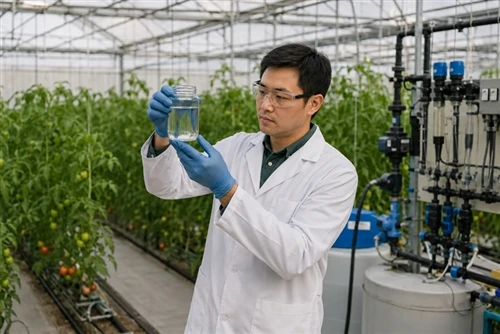
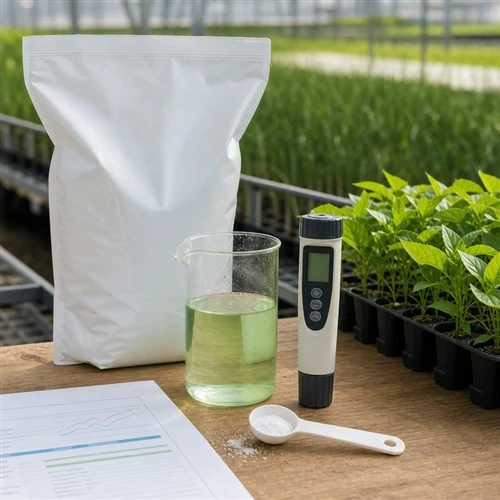
A jar test is simple and gives a useful early warning.
- Take irrigation water from the actual source. Use it at roughly the same temperature as during fertigation.
- Add the fertilizers at the same proportions and in the same mixing order planned for the field.
- Shake or stir until dissolved, then leave the jar undisturbed.
- Check it after 15 minutes and again after one to two hours.
The solution should remain uniform. Cloudiness, crystals, flakes, gel or sediment suggest that the mixture is unsafe for the irrigation system. A clear jar does not replace label instructions or professional advice, but it is far better than discovering incompatibility inside a full tank.
Mixing order also affects the result
Start with a clean tank and add enough water before fertilizer. Keep the agitator running, then add one product at a time and allow it to dissolve completely. Avoid dumping several powders into a small volume of water.
Never add an unknown acid directly to a fertilizer concentrate. Water acidification can help in some hard-water situations, but acid type, dose, injection equipment and operator safety all require proper control.
After fertigation, flush the tank, filters and irrigation lines with clean water. This reduces nutrient deposits and prevents leftover material from reacting with the next batch.
A short pre-mixing checklist
Before injection, confirm:
- the irrigation-water pH, hardness and bicarbonate level;
- each product's recommended concentration and application method;
- whether calcium is separated from phosphate and sulfate concentrates;
- that the jar test remains clear after standing;
- that filters are clean and the system will be flushed afterward.
Reliable fertigation depends on more than a strong formula. Solubility, water quality, concentration and mixing sequence must work together.
If you are selecting a macroelement water-soluble fertilizer or need a formula for a particular irrigation system, send us your crop, water analysis and planned application method. We can help review the practical fit before sampling or bulk supply.
You might be interested in:
How to Read Water-Soluble Fertilizer Parameters and Choose the Right Product
Macroelement Water Soluble Fertilizer