Essential Plant Nutrients and Their Roles in Crop Growth Part 2: How Calcium Magnesium and Sulfur Support Healthy Crops
After nitrogen, phosphorus and potassium, the next nutrients to consider are calcium, magnesium and sulfur. They support developing tissues, photosynthesis and protein formation. Managing them requires more than checking how much is in a fertilizer bag: root health, water supply and competition between nutrients also affect the outcome.

Calcium must reach developing tissues
Calcium helps maintain cell walls and membrane stability. Root tips, young leaves and developing fruit need a continuing supply. Calcium already stored in older tissues is not readily redistributed, so local shortages often affect young growth or fruit rather than first causing uniform yellowing of older leaves.
Blossom end rot in tomatoes and peppers, and tipburn in some leafy vegetables, can be associated with inadequate calcium reaching sensitive tissues. The soil itself may contain sufficient calcium. Uneven moisture, damaged roots, high salinity and rapid growth can all disrupt delivery. A normal calcium result from a leaf sample does not necessarily rule out a local shortage in fruit.
Stabilize moisture in the root zone, maintain drainage and check roots and salinity before increasing fertilizer. Avoid pushing excessive vegetative growth with nitrogen. If testing confirms an inadequate calcium supply, select a source suited to the growing system. Dead fruit tissue will not recover; the aim is to protect subsequent growth. Foliar calcium can be a supplementary treatment in appropriate situations, but calcium deposited on leaves has limited movement into fruit.

Magnesium keeps functional leaves productive
Magnesium is the central atom in chlorophyll and is involved in many enzyme reactions. A shortage reduces the ability of leaves to support crop growth. Because magnesium can move from older tissues to younger growth, deficiency commonly appears first on older leaves as yellowing between veins that remain relatively green. Severe cases may develop dead tissue.
This pattern differs from the more uniform paling often associated with nitrogen deficiency, but disease and natural aging must still be considered. Acidic, leaching prone soils deserve attention, as do fields receiving repeated heavy potassium applications. Adding a little magnesium while continuing excessive potassium feeding may leave the underlying imbalance unresolved.
Sulfur helps turn nitrogen into proteins
Sulfur forms part of certain amino acids and is essential for protein synthesis. When sulfur is limiting, a generous nitrogen supply may not be used effectively. Sulfur also contributes to characteristic compounds in crops such as onions, garlic and brassicas, although extra sulfur does not automatically improve flavor.
Sulfur deficiency may cause pale, slow growth and is often more apparent in younger leaves. It can be confused with nitrogen deficiency. Interpret leaf position alongside soil texture, organic matter, rainfall and fertilizer history. Sandy soils low in organic matter and systems using few sulfur containing inputs deserve particular attention.
Nutrition deficiency problems?
Choose sources by their full nutrient contribution
Calcium nitrate supplies nitrate nitrogen as well as calcium. Count that nitrogen when managing vigorous crops. Magnesium sulfate supplies both magnesium and sulfur, so check the need for both. Product analyses may express calcium and magnesium as elements or as oxide equivalents; compare them on the same basis.
Lime and dolomitic materials can supply calcium or magnesium while changing soil pH. They are not universal substitutes for soluble crop feeds. Gypsum supplies calcium and sulfur but does not neutralize soil acidity in the way lime does. Soil amendment granules and products formulated for fertigation serve different purposes.
Plan fertilizer compatibility and irrigation together
Calcium salts can react with phosphates and sulfates in concentrated stock solutions, creating precipitates. Fertigation systems commonly keep incompatible concentrates in separate stock tanks or apply them separately. Compatibility after dilution depends on concentration, formulation and water quality. Follow product and equipment guidance; a mixture that initially looks clear is not proof of trouble free operation.
A practical sequence is to correct water and root zone problems, establish the nutrient shortage, and then choose the source and application method. There is no reliable universal field rate or foliar dilution without knowing the crop, product concentration and growing conditions. Where salinity is already high, stacking several nutrient products can make matters worse.

Continue the series
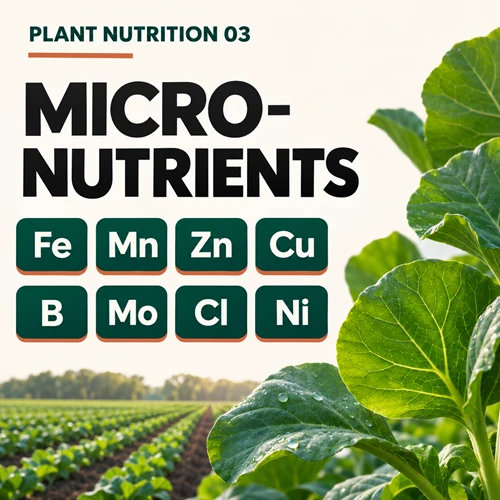
The final article covers iron, zinc, boron and the other essential micronutrients. It explains how to identify a likely shortage and why small nutrient requirements call for careful, targeted applications.
Series links:
Part 1: How Nitrogen Phosphorus and Potassium Affect Crop Growth
Part 3: How to Identify and Correct Micronutrient Deficiencies
Further reading:
Plant nutrients in the soil
https://www.dpird.nsw.gov.au/agriculture/soils/soil-testing-and-analysis/plant-nutrients
Soils and plant nutrients
https://content.ces.ncsu.edu/extension-gardener-handbook/1-soils-and-plant-nutrients
Soils, plant nutrition and nutrient management
https://extension.missouri.edu/publications/mg4
To discuss a formulation, request a sample or learn more about OEM services, contact us: