

Amino Acid Leaf Nourish Liquid Fertilizer with Alginate Oligosaccharides
1. Introduction
Leaf production is not limited to leafy vegetables. Tea, nursery plants, young field crops and fruiting vegetables all pass through stages when the working canopy determines how effectively the crop captures light and supports later development. The nutrient program used during this period should match the condition of the leaves without automatically adding another high-rate general fertilizer.
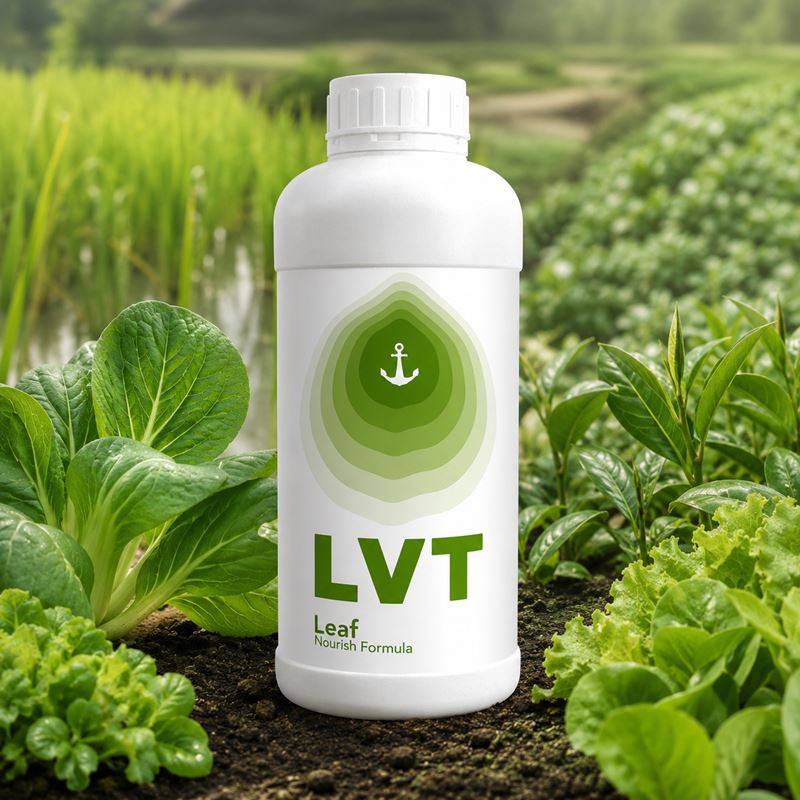
LVT Amino Acid Leaf Nourish Liquid Fertilizer is formulated for that role. Its organic base contains at least 100 g/L amino acids, 56.6 g/L organic matter and 4 g/L alginate oligosaccharides. NK is declared at 60 g/L, while boron, zinc, iron, magnesium, manganese and copper form the accompanying mineral package.
The product is a green clear liquid with a density of 1.18 g/mL and a pH of 7.5 ± 0.5. It is packed in a 1 L bottle and intended for whole-canopy foliar spraying after dilution at 500–800 times. Application should be timed around active leaf development and coordinated with the crop's existing base-fertilizer and micronutrient inputs.
2. Designed Around the Working Canopy
This formula is not simply an amino acid concentrate with a small amount of trace elements. The inclusion of NK, alginate oligosaccharides and six declared mineral nutrients gives it a distinct leaf-nutrition profile.
Boron at 10 g/L and zinc at 7.25 g/L are the leading mineral components. Iron, manganese and magnesium follow at lower but clearly stated concentrations, while copper is included at 0.28 g/L. This balance separates the product from a single iron treatment, a high-magnesium greening fertilizer or an NPK feed intended to carry the complete seasonal program.
The formula is better treated as a scheduled canopy input. Before application, growers should review other products supplying boron, zinc or copper during the same period. Repeating several overlapping foliar products can increase the total mineral load without improving spray coverage or timing.
The words "Leaf Nourish" describe the intended application focus. They should not be interpreted as a guarantee of darker leaf color, faster harvest or protection against every cause of yellowing. Root condition, temperature, irrigation, salinity, disease and the complete nutrient balance can all influence canopy appearance.
3. Technical Data & Specifications
| Item | Specification |
|---|---|
| Amino Acids (AA) | ≥100 g/L |
| Organic Matter (OM) | ≥56.6 g/L |
| NK | ≥60 g/L |
| Alginate Oligosaccharides | ≥4 g/L |
| Boron (B) | ≥10 g/L |
| Zinc (Zn) | ≥7.25 g/L |
| Copper (Cu) | ≥0.28 g/L |
| Iron (Fe) | ≥2.6 g/L |
| Magnesium (Mg) | ≥1.1 g/L |
| Manganese (Mn) | ≥1.25 g/L |
| Chelation Technology | Amino acid chelation |
| Formulation | Concentrated clear liquid |
| Appearance | Green clear liquid |
| Density | 1.18 g/mL |
| pH | 7.5 ± 0.5 |
| Standard Package | 1 L bottle |
| Confirmed Application Method | Whole-canopy foliar spraying |
| Recommended Dilution | 1:500–800 |
4. How the Formula Is Layered
Amino acid and organic base
Amino acids are supplied at 100 g/L and also define the confirmed chelation technology. Organic matter is declared separately at 56.6 g/L. These figures describe composition; they do not establish a fixed absorption rate or eligibility for certified organic production.
Alginate oligosaccharides
Alginate oligosaccharides are included at 4 g/L. Their presence differentiates this product from a conventional amino-acid-and-trace-element liquid. They should be presented as a confirmed formulation component rather than as proof of disease resistance, stress immunity or a guaranteed biological response.
Declared NK contribution
NK is supplied at 60 g/L. Because the specification does not provide separate nitrogen and potassium guarantees, the page should not invent individual values or convert the declaration into an N-K ratio. Buyers requiring separate figures should request the applicable technical document.
Amino acid chelation
Amino acid chelation is used for the mineral portion of the formula. The clear-liquid presentation supports convenient measuring and tank preparation, but it does not guarantee stability with every water source, pesticide or additional fertilizer.
5. Interpreting the Micronutrient Profile
Boron and zinc lead the mineral package
Boron is declared at 10 g/L and zinc at 7.25 g/L. Both are meaningful parts of the formulation, so existing boron and zinc applications should be checked before the product is added to a foliar schedule. Crop tolerance and local labeling requirements remain important, particularly for repeated applications.
Iron, manganese and magnesium support a broader leaf program
Iron is supplied at 2.6 g/L, manganese at 1.25 g/L and magnesium at 1.1 g/L. Their inclusion broadens the formula beyond a boron-zinc product, but the fertilizer should not be positioned as a high-rate corrective source for a laboratory-confirmed severe deficiency of any one element.
Copper requires program awareness
Copper is present at 0.28 g/L. Growers should include this contribution when copper-containing pesticides or foliar nutrients are used in the same production cycle.
Discuss a Leaf Nutrition Specification
6. Crop Groups and Practical Use Windows
Leafy vegetables
Bok choy, lettuce, spinach, cabbage, kale and other commercial leafy vegetables may be considered during active leaf expansion. The spray should reach the working canopy evenly without pooling in the plant center or leaving heavy runoff on harvestable leaves.
Tea and managed perennial foliage
Tea and other crops harvested for vegetative growth require careful coordination with harvest intervals, local residue rules and the complete plantation fertilizer schedule. Application timing should be based on the development of the new flush rather than a fixed monthly calendar.
Field crops during canopy establishment
Rice, maize, wheat, beans and similar field crops may use a foliar micronutrient input during suitable vegetative stages where local crop analysis or agronomic practice supports it. On large areas, a representative strip test is preferable before full-block treatment.
Nurseries, ornamentals and turf
Nursery crops, foliage ornamentals and managed turf can vary substantially in spray tolerance. Begin at the more dilute end of the range and test a small group before treating the full production area.
Fruiting vegetables before heavy reproductive demand
Tomato, pepper, cucumber and eggplant may be considered during early canopy building. As flowering and fruit development advance, the fertilizer ratio should be reassessed against the crop's changing phosphorus, potassium and calcium requirements.
7. Application Directions
| Application Method | Recommended Dilution | Spray Target | Timing and Notes |
|---|---|---|---|
| Whole-canopy foliar spraying | 1:500–800 | Apply a fine, even spray to the active leaf canopy without excessive runoff or solution pooling | Apply during the cooler part of the day. Choose concentration according to crop sensitivity, canopy age, water quality and other nutrient inputs. |
The recommendations above represent the most suitable application methods and rates for this product. If you plan to use a different fertilization method, please contact us for specific guidance.

8. Coverage Strategy for Leaf-Dense Crops
Leaf-oriented crops often create a practical coverage problem: the upper canopy can intercept most of the spray while inner leaves receive little solution. Increasing the concentration does not correct poor nozzle direction.
Select a nozzle that produces fine, controlled droplets and adjust pressure to reduce drift. Move the lance steadily across the crop rather than holding it over one plant. On dense rows, direct the spray from an angle that reaches both the upper surface and accessible inner canopy without forcing liquid into plant centers.
Apply during a cool part of the morning or late afternoon. Avoid intense sunlight, high temperature, strong wind and imminent rainfall. Do not spray crops that are severely wilted, waterlogged or visibly damaged.
Half-fill the clean tank with water, begin agitation, measure the required fertilizer and add it gradually. Complete the final water volume and keep the mixture uniform during application. Use the prepared solution within the same working period and rinse the tank, hose and nozzle afterward.
9. Mixing, Storage and Specification Control
Complete a jar test before preparing an unfamiliar mixture. Use the actual spray water and the proportions planned for field application. Add materials one at a time in the intended sequence and observe the sample for persistent cloudiness, particles, sediment, gel, separation, excessive foam or unusual heat.
Do not combine undiluted fertilizer concentrates directly. A physically stable mixture does not prove crop safety, so pesticide, adjuvant, oil and plant-growth-regulator combinations should also be tested on a small area. Follow the most restrictive approved label in the tank.
For purchasing, labeling and registration work, verify the current version against these points:
- Organic matter is ≥56.6 g/L.
- Alginate oligosaccharides are ≥4 g/L.
- Boron is ≥10 g/L.
- NK remains a combined declaration of ≥60 g/L unless separate values are documented.
- The physical form is a green clear liquid.
- Density is 1.18 g/mL and pH is 7.5 ± 0.5.
- Whole-canopy foliar spraying at 500–800× is the confirmed use.
- The standard package is a 1 L bottle.
Keep the bottle tightly closed in a cool, dry and ventilated location. Protect it from direct sunlight, freezing and prolonged heat. Store it away from children, food, animal feed and incompatible chemicals. Inspect the liquid and packaging before use and follow the approved destination-market label.
10. FAQ
1. Can this product replace the crop's base NPK fertilizer?
It should be used as a stage-focused foliar supplement. It does not provide a confirmed complete NPK analysis and should not be presented as a replacement for the base nutrient program.
2. Is the same concentration suitable for every leafy crop?
No. Crop species, variety, leaf age, weather and water quality can affect tolerance. Begin at 1:800 on a small area before selecting a stronger concentration.
3. Can it be applied through fertigation or root drenching?
Whole-canopy foliar spraying at 500–800× is the only method confirmed for this page. Contact LVT for separate guidance before using another delivery method.
4. Can it be mixed with pesticides or other foliar fertilizers?
Compatibility depends on the spray water and the complete formulation of every product. Dilute materials properly, conduct a jar test and complete a small-area crop-safety test before full application.
5. Does the organic matter content mean the product is certified organic?
No. Organic matter and amino acids do not establish organic certification. Eligibility depends on raw materials, manufacturing process and the rules of the destination market.
Contact WEIFANG LVWEITE BIO-TECH CO., LTD. for:
- Product samples
- Technical data and COA
- MSDS
- OEM packaging
- Private-label production
- Export quotations
- Registration support
Hot Tags: amino acid leaf nourish fertilizer with alginate | lvt, China amino acid leaf nourish fertilizer with alginate | lvt manufacturers, suppliers, factory