
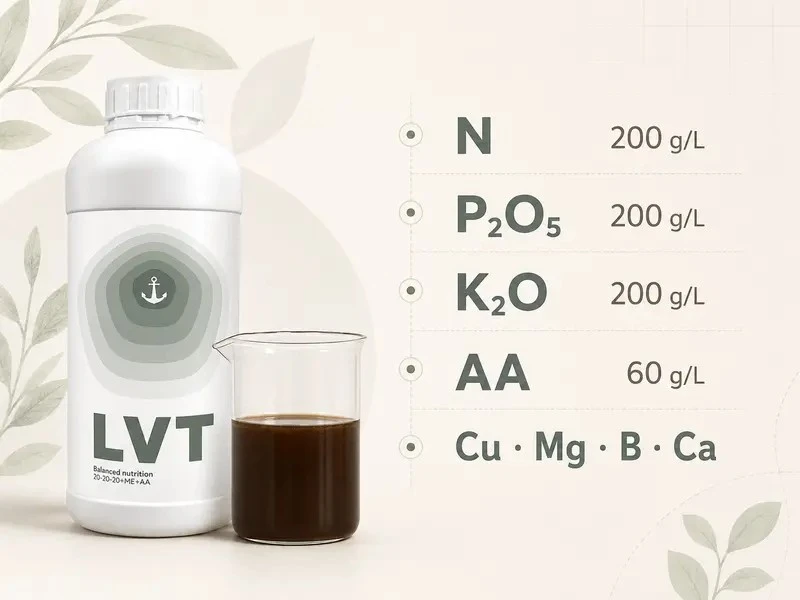
Liquid NPK 20-20-20 Fertilizer with Amino Acids
Introduction
Crop nutrient requirements change throughout the production cycle. A high-nitrogen formula may suit rapid leaf development, while flowering and fruit-filling stages often require different nutrient proportions. Between these more targeted stages, growers may need a balanced fertilizer that supplies all three primary macronutrients without allowing one element to dominate the program.
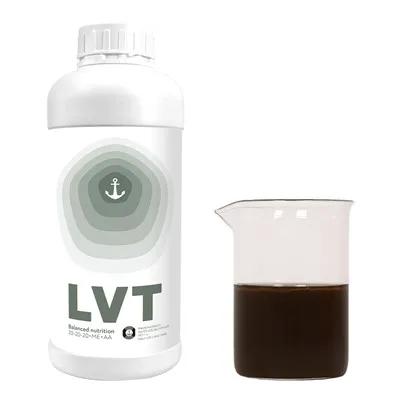
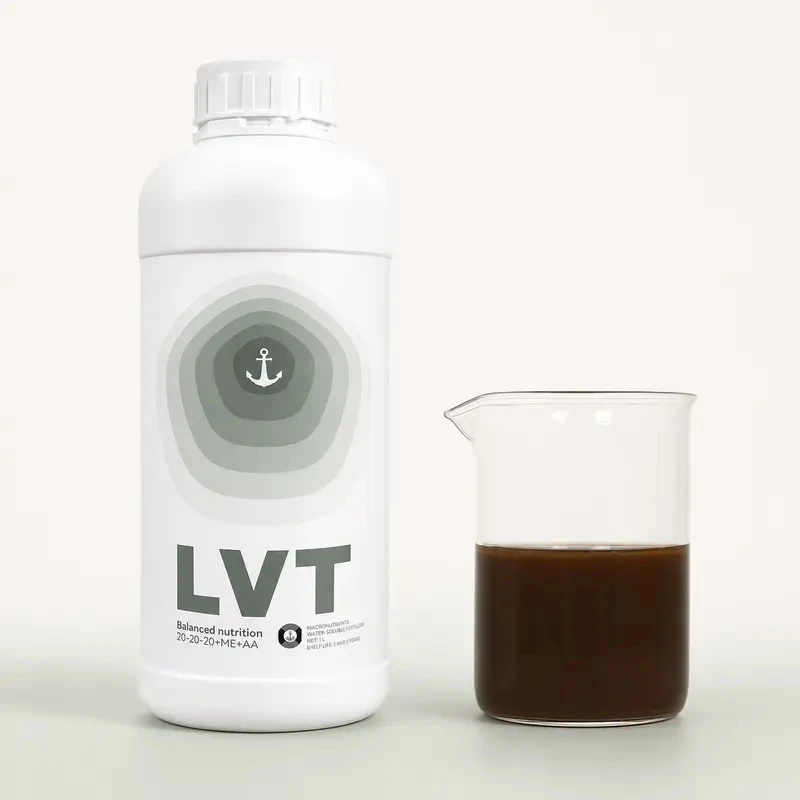
This liquid NPK fertilizer provides nitrogen, phosphorus pentoxide and potassium oxide at 200 g/L each. Its equal nutrient relationship makes it suitable for routine feeding during active, relatively balanced growth. Amino acids are included at 60 g/L, while boron, calcium, magnesium and copper broaden the formulation beyond basic NPK.
These supplementary contents should be considered part of the overall nutrition plan rather than replacements for dedicated calcium, magnesium or micronutrient treatments where crop demand is high.
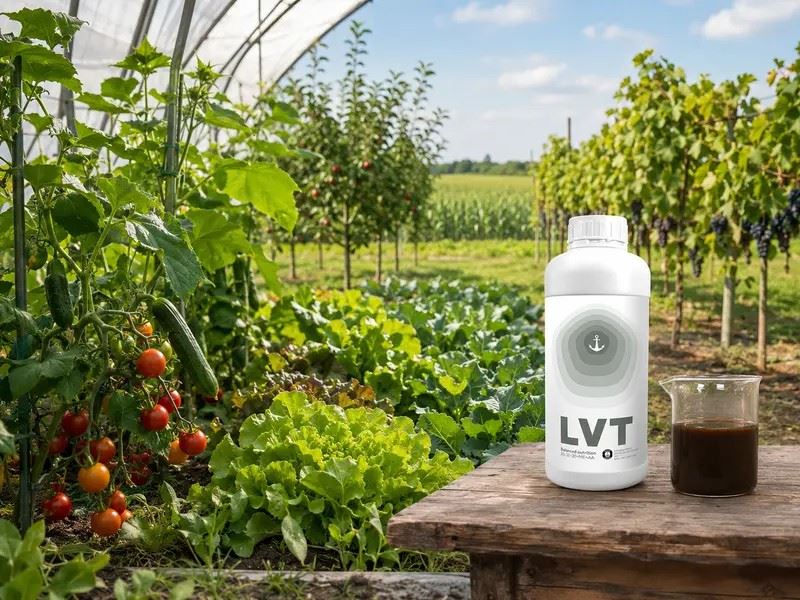
The concentrated liquid can be measured and diluted for several application systems, allowing distributors and growers to position one product across open-field, greenhouse and nursery projects.
Technical Data & Specifications
| Parameter | Guaranteed content |
|---|---|
| Nitrogen (N) | ≥200 g/L |
| Phosphorus Pentoxide (P₂O₅) | ≥200 g/L |
| Potassium Oxide (K₂O) | ≥200 g/L |
| Copper (Cu) | ≥0.1 g/L |
| Magnesium (Mg) | ≥0.1 g/L |
| Boron (B) | ≥2.0 g/L |
| Calcium (Ca) | ≥0.2 g/L |
| Amino Acids (AA) | ≥60 g/L |
| Organic Matter | ≥120g/L |
| Formulation | Concentrated liquid |
| Appearance | Dark brown liquid |
| NPK nutrient relationship | 1:1:1 |
| Standard package | 1 L/bottle |
Where This Formula Fits
General feeding periods
The equal NPK relationship is appropriate when the crop requires continued macronutrient supply but does not yet need a stage-specific high-phosphorus or high-potassium formulation.
Programme transitions
The product can be positioned between specialized fertilizer stages-for example, after early establishment and before a crop enters intensive flowering or fruit development.
Mixed crop operations
Farms growing several crop types may use a balanced formula as a general-purpose component, while retaining targeted products for crops or stages with distinctly different requirements.
Supplementary foliar feeding
Foliar application provides another route for delivering a diluted nutrient solution during active growth. It should complement, rather than automatically replace, the main soil or substrate fertilizer program.
Suitable Application Stages
This balanced formulation may be incorporated into crop programs during:
- Early establishment after successful rooting
- Active vegetative development
- Canopy expansion
- Recovery following transplanting
- Periods of broad nutritional demand
- Nutritional maintenance between stage-specific applications
- Growth periods when no single macronutrient needs to dominate
For flowering, fruit expansion or ripening stages, the overall fertilizer program may need to shift toward a crop-specific nutrient ratio.
Suitable Production Systems
The formula may be considered for:
- Greenhouse vegetables
- Open-field vegetable crops
- Melons and berries
- Grapes and established orchards
- Corn and other field crops
- Flowers and ornamental plants
- Commercial nurseries
- Substrate-grown crops
A crop-specific feeding plan may require a different NPK relationship during rooting, flowering, fruit expansion or ripening.
Application Recommendations
| Application method | Dilution | Suggested interval |
|---|---|---|
| Fertigation | 600–800 times | Every 10–15 days |
| Foliar spraying | 500–800 times | Every 7–10 days |
| Root drenching | 500–600 times | Every 10–15 days |
Practical Dilution Guide:
| Product quantity | 500× | 600× | 800× |
|---|---|---|---|
| 100 mL | 50 L water | 60 L water | 80 L water |
| 500 mL | 250 L water | 300 L water | 400 L water |
| 1 L | 500 L water | 600 L water | 800 L water |
Preparation and Application:
Fertigation
Pre-dilute the required amount before introducing it into the irrigation system. Apply the nutrient solution during the irrigation cycle, then finish with clean water to rinse the lines.
Foliar Spraying
Use clean water and apply an even, fine spray to the crop canopy. Avoid excessive runoff. Morning or late-afternoon application is preferable to spraying during strong sunlight, high temperature, wind or imminent rainfall.
Root Drenching
Distribute the diluted solution through the active root area. Avoid pouring concentrated fertilizer directly against the stem or into dry growing media.
Tank Mixing
- Shake or agitate the container before measuring.
- Dilute the fertilizer before adding other tank-mix products.
- Add products to the tank individually rather than combining concentrates.
- Conduct a jar test when using unfamiliar combinations.
- Avoid direct concentrated mixing with calcium-rich fertilizers, phosphates or strongly alkaline products.
- Stop mixing if sediment, separation, excessive foam or abnormal heat develops.
- Check crop-protection product labels before preparing fertilizer–pesticide mixtures.
- Use the mixed solution within the same application period.
Hard water, bicarbonates and unsuitable tank pH may affect solution stability.
Packaging and Storage
Standard packaging:
1 L plastic bottle
Export carton configuration according to order requirements
Customized packaging:
- 500 mL bottles
- Alternative 1 L bottle designs
- 5 L and 20 L containers
- 200 L drums
- Private-label packaging
- Multilingual labels
- Customized export cartons and pallets
Keep containers tightly closed in a dry, ventilated location. Protect the product from direct sunlight, freezing and prolonged exposure to excessive heat. Keep out of reach of children and away from food, animal feed and drinking water.
FAQ
1. How does this formula differ from the 17-17-17 product?
This version contains 200 g/L each of N, P₂O₅ and K₂O, compared with 170 g/L in the 17-17-17 formula. It also has a different supplementary nutrient profile, including 60 g/L amino acids, 2.0 g/L boron and 120 g/L organic matter.
2. Does 20-20-20 represent weight percentages?
The commercial name describes the product's balanced NPK positioning. Its formal guaranteed analysis is expressed in grams per litre: N ≥200 g/L, P₂O₅ ≥200 g/L and K₂O ≥200 g/L.
3. Why are amino acids included in the formula?
They provide an organic nitrogen-containing component that complements the mineral NPK profile. The product contains at least 60 g/L amino acids.
4. Can this product replace a separate calcium fertilizer?
No. Its calcium content is supplementary. Crops with a high calcium requirement may still need a dedicated calcium programme based on water, soil or tissue analysis.
5. Can it be used in hard irrigation water?
It may be used after checking water quality and solution stability. A small mixing test is recommended when the water contains high levels of calcium, magnesium or bicarbonates.
6. Is private-label production available?
Yes. Formula specifications, bottle sizes, labels, cartons and application directions can be customized for distributors, subject to production and destination-market requirements.
Contact WEIFANG LVWEITE BIO-TECH CO., LTD. for:
- Product samples
- Technical data and COA
- MSDS
- OEM packaging
- Private-label production
- Export quotations
- Registration support
Hot Tags: Liquid NPK 20-20-20 Fertilizer with Amino Acids, China Liquid NPK 20-20-20 Fertilizer with Amino Acids manufacturers, suppliers, factory, Amino acid NPK fertilizer, balanced water soluble fertilizer, Balanced Water Soluble NPK Fertilizer 20 20 20, NPK 17 17 17 fertilizer for vegetables, NPK fertilizer with medium elements, Water soluble NPK fertilizer 17 17 17