Zinc Amino Acid Fertilizer for Corn
Introduction
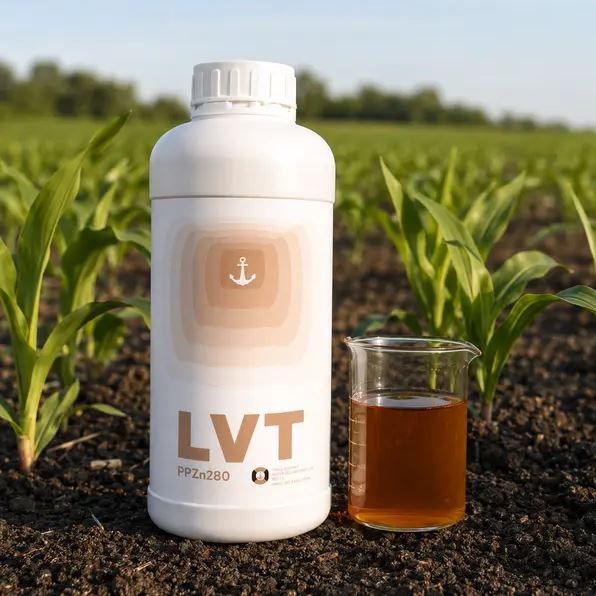
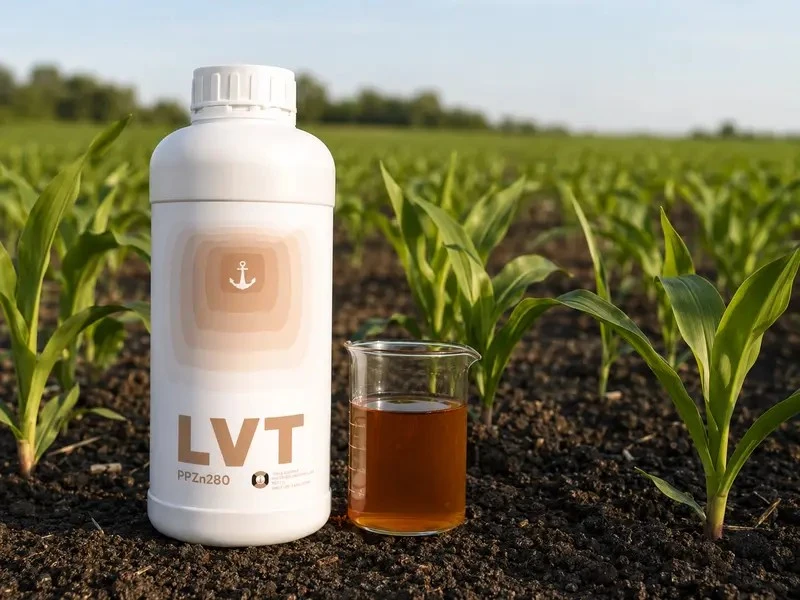
Our Zinc Amino Acid Fertilizer for Corn is a concentrated liquid micronutrient fertilizer developed to supplement zinc nutrition during corn establishment and early vegetative growth.
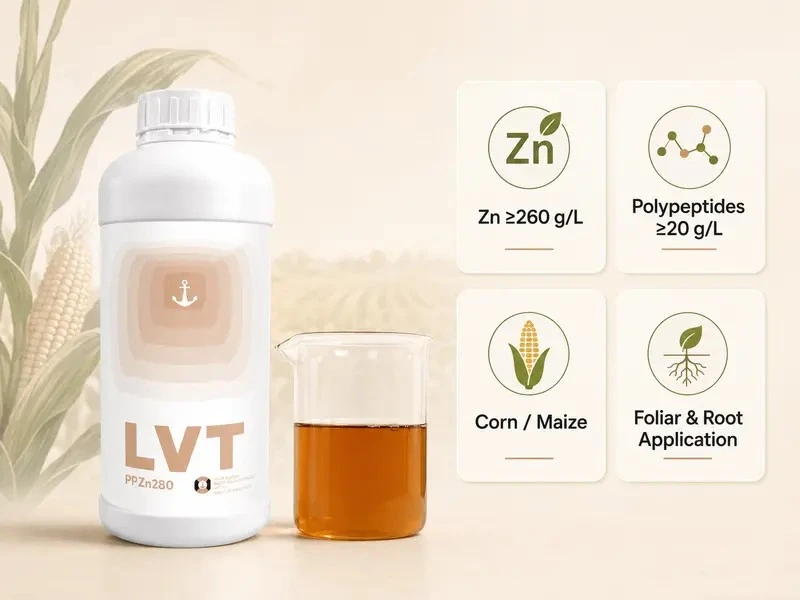
The formulation supplies at least 260 g/L chelated zinc together with at least 20 g/L polypeptides. It is intended for use in fields where soil testing, plant-tissue analysis, field history or visible crop symptoms indicate that zinc availability may limit corn development.
Corn is one of the crops most responsive to zinc fertilization when soil zinc availability is low. Zinc participates in multiple enzyme systems and metabolic processes associated with normal plant growth. An adequate zinc supply is particularly important during early crop establishment, when cool soil, restricted root growth or unsuitable soil conditions may reduce zinc uptake.
This product may be applied through foliar spraying, fertigation or root-zone application. The most appropriate method and rate should be selected according to soil test results, crop stage, field conditions and local fertilizer recommendations.
Technical Data & Specifications
| Parameter | Guaranteed content |
|---|---|
| Zinc (Zn) | ≥260 g/L |
| Polypeptides | ≥20 g/L |
| Physical form | Concentrated liquid |
| pH value | 4.5–6.5 |
| Density | 1.35–1.46 g/mL |
| Primary crop | Corn / maize |
| Other potential crops | Citrus, grapes and broadleaf crops |
Why Corn Needs Zinc
Zinc is required in relatively small quantities, but insufficient availability can restrict normal corn growth.
It is involved in:
- Enzyme activation
- Protein synthesis
- Carbohydrate metabolism
- Regulation of plant growth
- Development of new leaves and growing points
- Normal internode and leaf development
- Maintenance of general metabolic activity
Corn is classified as a crop with a comparatively high probability of responding to zinc when soil zinc levels are low. However, zinc application should not be automatic in every field. Soil testing remains the preferred basis for deciding whether zinc fertilizer is required.
Recognizing Possible Zinc Deficiency in Corn
Typical zinc-deficiency symptoms in young corn may include:
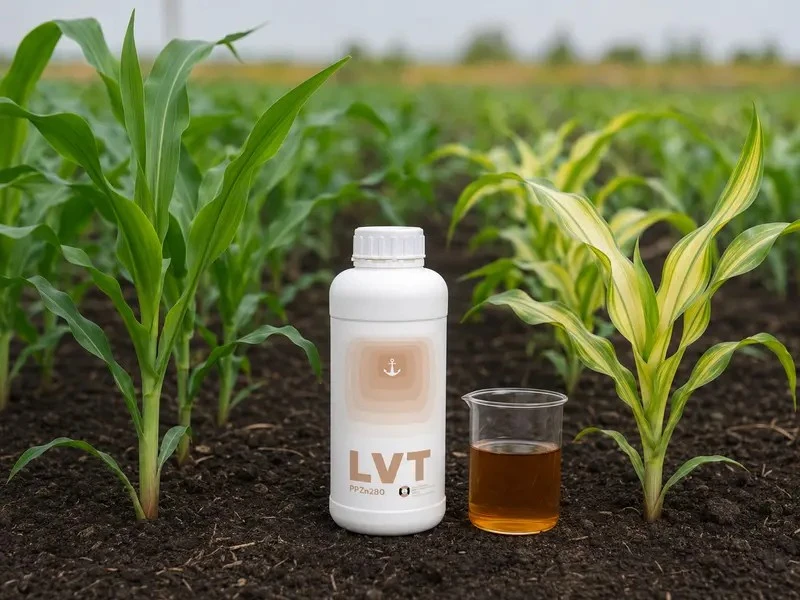
- Broad pale-yellow or white bands on both sides of the midrib
- Striping beginning near the base of younger leaves
- A green midrib and green leaf margins surrounding the pale bands
- Shortened internodes
- Stunted or uneven plant growth
- Delayed early development
- Severe cases producing very pale new leaves
- Symptoms often appear during the first two or three weeks of growth.
However, visual symptoms alone are not sufficient for diagnosis. Similar appearances can result from:
- Cool-weather stress
- Root injury
- Herbicide damage
- Soil compaction
- Poor drainage
- Sulfur or other nutrient deficiencies
- Uneven fertilizer placement
Key Nutritional Benefits
1. Concentrated Zinc Supplementation
The formulation supplies at least 260 g/L zinc and is designed for situations where corn requires additional zinc nutrition.
When applied at a suitable rate to a genuinely zinc-deficient crop, it can support:
- Normal development of young leaves
- Early vegetative growth
- Normal internode development
- Enzyme and metabolic functions
- More uniform crop establishment
2. Polypeptide-Based Nutrient Matrix
The formula contains at least 20 g/L polypeptides. These organic components form part of the liquid nutrient matrix and may improve formulation characteristics and compatibility with crop-nutrition programs.
3. Suitable for Early-Season Foliar Nutrition
Foliar application can be useful when young corn displays confirmed or strongly suspected zinc deficiency during the growing season.
A properly diluted foliar application may help supplement zinc through the leaf surface. However, foliar treatment should not be presented as a substitute for correcting a persistent low-zinc soil condition.
4. Flexible Application Methods
The liquid formulation may be used through:
- Foliar spraying
- Fertigation
- Root-zone drenching
- Compatible liquid fertilizer programmes
Because the zinc concentration is high, accurate dilution, calibration and agitation are essential.
5. Suitable for OEM Crop-Specific Products
The formula may be positioned for:
- Corn and maize nutrition programmes
- Micronutrient correction products
- Early-growth foliar fertilizers
- High-pH soil markets
- Customized private-label products
- Crop-specific zinc packages
Recommended Crops
The primary positioning of this page is:
- Field corn
- Silage corn
- Sweet corn
- Maize grown under irrigation
- High-yield commercial corn
After local evaluation, the product may also be considered for:
- Citrus
- Grapes
- Beans
- Onions
- Broadleaf vegetables
- Other zinc-responsive crops
Application rates should not be copied directly from corn to other crops.
Application Recommendations
| Application method | Suggested dilution | Suggested interval | Recommended use |
|---|---|---|---|
| Foliar spraying | 1:1,000–1,500 | According to diagnosis; repeat only if necessary | Supplementary or corrective zinc application |
| Fertigation | 1:800–1,000 | Every 10–15 days when justified | Irrigated corn or other suitable crops |
| Root drenching | 1:600–800 | Every 10–15 days when justified | Localized root-zone application |
Practical Corn Management Recommendations
For better results:
- Test the soil before establishing a zinc programme.
- Inspect uneven, eroded and high-pH areas separately.
- Confirm visual symptoms with tissue analysis where possible.
- Apply zinc early enough to support young crop development.
- Calibrate sprayers carefully.
- Maintain uniform spray coverage without excessive runoff.
- Consider all zinc sources already included in starter fertilizers.
- Avoid unnecessary repeated applications.
- Correct drainage, compaction or root problems where present.
- Maintain balanced nitrogen, phosphorus, potassium and sulfur nutrition.
- Keep untreated comparison strips when evaluating the product commercially.
Foliar Application Precautions
When applying the product to corn leaves:
- Dilute the concentrate thoroughly before spraying.
- Spray during cooler parts of the day.
- Avoid application under intense sunlight or high temperatures.
- Do not spray severely drought-stressed crops.
- Avoid spraying immediately before heavy rain.
- Test on a small area before full-field application.
- Use clean water with suitable pH and hardness.
- Prevent overlap at headlands and field edges.
- Stop application if leaf spotting or burning occurs.
- Follow all local label and worker-safety requirements.
Remarks: A foliar zinc application should not automatically be expected to increase yield in a field without zinc deficiency.
Tank-Mix Compatibility
Before combining this product with other fertilizers or pesticides:
- Conduct a small jar test.
- Add the product only after it has been pre-diluted.
- Maintain agitation during preparation and application.
- Avoid concentrated mixtures with phosphate fertilizers.
- Avoid highly alkaline products.
- Exercise caution with lime-containing materials.
- Check pesticide labels before tank mixing.
- Do not assume compatibility based only on the pH range.
- Apply incompatible products separately.
- Clean and flush application equipment after use.
Packaging and OEM Service
Standard packaging options:
500 mL, 1 L, 20 L, 200 L
Customized packaging is available upon request, including:
- Private-label production
- Customized label design
- Different bottle and drum sizes
- Customer-specific nutrient specifications
- Multilingual labels
- Export cartons and palletized packaging
- COA and MSDS documentation
- Sample supply for evaluation
Final packaging and label information can be adjusted according to the registration requirements of the importing country.
FAQ
1. When should zinc fertilizer be applied to corn?
In fields with a known zinc deficiency, the main zinc program should preferably be planned before or at planting. Foliar application may be used during early vegetative growth when deficiency is confirmed or strongly suspected.
2. What does zinc deficiency look like in young corn?
Common symptoms include broad pale-yellow or white bands on both sides of the midrib, shortened internodes and stunted early growth. Laboratory or soil analysis is recommended because other stresses can cause similar symptoms.
3. Can this product guarantee higher corn yield?
No. A yield response is most likely where zinc availability is genuinely limiting crop growth. Applying additional zinc to a field with sufficient zinc may provide no economic benefit.
4. Can it cure severely damaged plants?
It may provide zinc nutrition to newly developing tissue, but tissue already seriously damaged will not return to its original condition. Crop recovery also depends on root health, weather, growth stage and the severity of the deficiency.
5. Can it be sprayed together with herbicides?
Compatibility depends on the herbicide formulation, water quality, adjuvants and application conditions. A jar test and small-area crop-safety test should be completed first. The pesticide label always takes priority.
6. Can it be mixed with phosphorus fertilizer?
Avoid mixing the concentrated zinc product directly with concentrated phosphate fertilizer unless compatibility has been confirmed. Dilute products separately or apply them at different times if precipitation occurs.
7. Is foliar application better than soil application?
The two methods serve different purposes. Foliar application can provide in-season supplementation, while soil or starter application is generally more suitable for fields with a recurring, soil-based zinc deficiency.
8. Is the product suitable for sweet corn?
Yes, it may be used in sweet-corn zinc programs after the rate has been adjusted according to local recommendations and crop-safety testing.
9. Is OEM production available?
Yes. OEM services can include customized nutrient specifications, packaging, labels, technical documents and export cartons.
Contact WEIFANG LVWEITE BIO-TECH CO., LTD. for:
- Product samples
- Technical data
- COA and MSDS
- OEM packaging
- Private-label production
- Export quotation
- Registration document support
Hot Tags: zinc amino acid fertilizer for corn, China zinc amino acid fertilizer for corn manufacturers, suppliers, factory