

Products Description
Introduction
Fruit coloration develops gradually as the crop approaches physiological maturity. The visible result depends on cultivar, sunlight, day-and-night temperature differences, crop load, water management and the overall nutrition program. Fertilizer can support this stage, but it cannot replace suitable environmental and crop-management conditions.
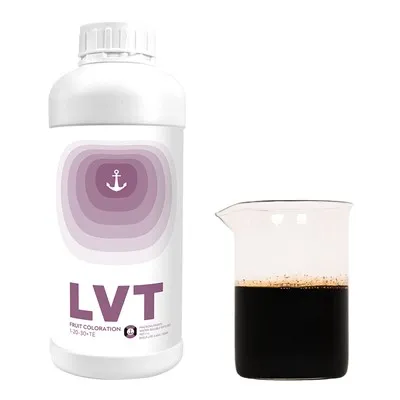
LVT Fruit Coloration Liquid Fertilizer is formulated with a low nitrogen concentration of 10 g/L and a potassium-led macronutrient profile. Each litre contains at least 200 g of phosphorus pentoxide and 300 g of potassium oxide, accompanied by magnesium and seven declared trace elements.
The formulation also supplies 100 g/L amino acids and 126.5 g/L organic matter. It is produced as a deep-brown suspension with a density of 1.52 g/mL and a pH of 6.5–7.5. The product is intended for stage-specific nutrition as fruit moves from enlargement toward natural color development and ripening.
Key Benefits
2.1 Low-nitrogen positioning
Nitrogen is limited to 10 g/L, making it a minor part of the macronutrient profile. This distinguishes the product from nitrogen-led formulas used during periods of active vegetative growth.
2.2 Potassium-led late-stage nutrition
Potassium oxide is supplied at 300 g/L. This makes potassium the principal declared macronutrient and positions the formula for fruit crops approaching the later part of their production cycle.
2.3 Phosphorus contribution
The product contains 200 g/L phosphorus pentoxide. Its inclusion should be considered alongside soil phosphorus levels, base fertilizer and other phosphate-containing products used during the season.
2.4 Amino acids and organic matter
Amino acids and organic matter broaden the formulation beyond mineral NPK. Their presence does not, by itself, establish organic-farming certification or guarantee a specific response under all growing conditions.
2.5 Broad micronutrient profile
Magnesium, copper, iron, manganese, molybdenum, boron and zinc are included at declared concentrations. These nutrients should be assessed together with crop analysis, irrigation-water quality and other micronutrient inputs.
Technical Data & Specifications
| Item | Specification |
|---|---|
| Nitrogen (N) | ≥10 g/L |
| Phosphorus Pentoxide (P₂O₅) | ≥200 g/L |
| Potassium Oxide (K₂O) | ≥300 g/L |
| Magnesium (Mg) | ≥0.1 g/L |
| Copper (Cu) | ≥0.2 g/L |
| Iron (Fe) | ≥0.5 g/L |
| Manganese (Mn) | ≥0.3 g/L |
| Molybdenum (Mo) | ≥0.003 g/L |
| Boron (B) | ≥2.2 g/L |
| Zinc (Zn) | ≥0.3 g/L |
| Amino Acids (AA) | ≥100 g/L |
| Organic Matter | ≥126.5 g/L |
| Formulation | Suspension liquid |
| Appearance | Deep-brown suspension |
| Density | 1.52 g/mL |
| pH | 6.5–7.5 |
| Reference Package | 1 L bottle |
| Available Service | OEM and private label |
Recommended Application Stage
The product is positioned for the transition between completed fruit enlargement and natural color development.
Typical visual indicators include:
- Apples beginning to develop a light blush on sun-exposed surfaces
- Red or purple grapes entering veraison
- Citrus peel beginning to change from green
- Tomatoes moving from mature green toward breaker stage
- Peppers, stone fruit or berries beginning their normal cultivar-specific color change
- Application timing should follow actual crop development rather than a fixed calendar date. Using a coloring-stage fertilizer too early may not match the crop's current nutrient requirements.

Application Directions
| Method | Recommended Rate | Application Stage | Notes |
|---|---|---|---|
| Foliar Spraying | Dilute 800–1000 times and spray the entire plant | From the onset of natural color break through early ripening | Final method and rate depend on crop type, equipment, climate, water quality and existing fertilizer inputs |
The recommendations above represent the most suitable application methods and rates for this product. If you plan to use a different fertilization method, please contact us for specific guidance.
Get assistance from our technician
Suitable Crops
6.1 Orchard crops
- Apple and pear
- Peach, nectarine and plum
- Citrus
- Pomegranate and persimmon
6.2 Vine and berry crops
- Table and wine grapes
- Strawberry
- Raspberry, blueberry and other berry crops
6.3 Fruiting vegetables
- Tomato
- Sweet pepper
- Eggplant
6.4 Melon crops
- Watermelon
- Melon and other color-dependent cucurbits
The expected color pattern differs by crop and variety. The product should not be used to pursue a color that is not genetically characteristic of the cultivar.
Mixing and Compatibility
Shake or agitate the container thoroughly before measuring because the product is a suspension rather than a clear solution.
When preparing a new mixture:
- Use clean water and a clean tank.
- Add part of the required water before introducing the fertilizer.
- Add the measured product gradually while maintaining agitation.
- Dilute other inputs separately before adding them.
- Conduct a small jar test before preparing the full tank.
- Maintain suitable agitation during preparation and application.
- Clean filters, nozzles and equipment after use.
Extra caution is required when combining phosphate-containing fertilizers with concentrated calcium products. Do not use a mixture that develops persistent sediment, separation, excessive foam or abnormal heat.
Practical Precautions
Do not treat fruit coloration as a fertilizer-only process. Poor light penetration, excessive crop load, unsuitable temperature, irregular irrigation, canopy shading or harvesting before physiological maturity may limit natural color development.
Avoid unnecessary late nitrogen inputs unless supported by crop analysis. Follow the complete fertilizer program and consider nutrients already supplied through soil, fertigation and foliar treatments.
For a new crop, cultivar or tank mixture, test a limited area before treating the full production block.
Storage and Handling
Store the product in its original closed container in a cool, ventilated place. Protect it from direct sunlight, freezing conditions and excessive heat.
Keep the fertilizer separate from food, animal feed and drinking water. Wear appropriate protective equipment when measuring, mixing and applying the product, and follow the current MSDS and label instructions.
FAQ
1 Can this fertilizer guarantee red or uniform fruit color?
No. Coloration also depends on cultivar, light, temperature, maturity, crop load, water management and canopy conditions. The product provides nutritional support rather than a guaranteed color result.
2 Does 1-20-30 mean percentage by weight?
Not automatically. The confirmed macronutrient analysis is N ≥10 g/L, P₂O₅ ≥200 g/L and K₂O ≥300 g/L.
3 When should the product be introduced?
It may be considered when fruit enlargement is largely complete and the crop begins its natural color transition. The exact timing varies by crop and cultivar.
4 Can it be mixed with calcium fertilizer?
Concentrated phosphate and calcium products may form precipitates. Separate application is generally safer unless compatibility has been confirmed by the technical department and a jar test.
5 Can it be used for foliar spraying or fertigation?
The latest method and rate have not yet been confirmed. Contact LVT with the crop, growth stage and intended equipment before publishing or using a specific application direction.
6 Why should the container be agitated before use?
The product is a suspension. Agitation helps redistribute settled components and improves consistency when measuring and preparing the diluted fertilizer.
Contact WEIFANG LVWEITE BIO-TECH CO., LTD. for:
- Product samples
- Technical data and COA
- MSDS
- OEM packaging
- Private-label production
- Export quotations
- Registration support
Hot Tags: fruit coloration liquid fertilizer 1-20-30 + aa | lvt, China fruit coloration liquid fertilizer 1-20-30 + aa | lvt manufacturers, suppliers, factory, Flowering promoting fertilizer, functional npk water soluble fertilizer, NPK fertilizer for coloration, NPK fertilizer for fruit setting, Potassium fertilizer for fruit coloration, Water soluble fertilizer for coloring stage