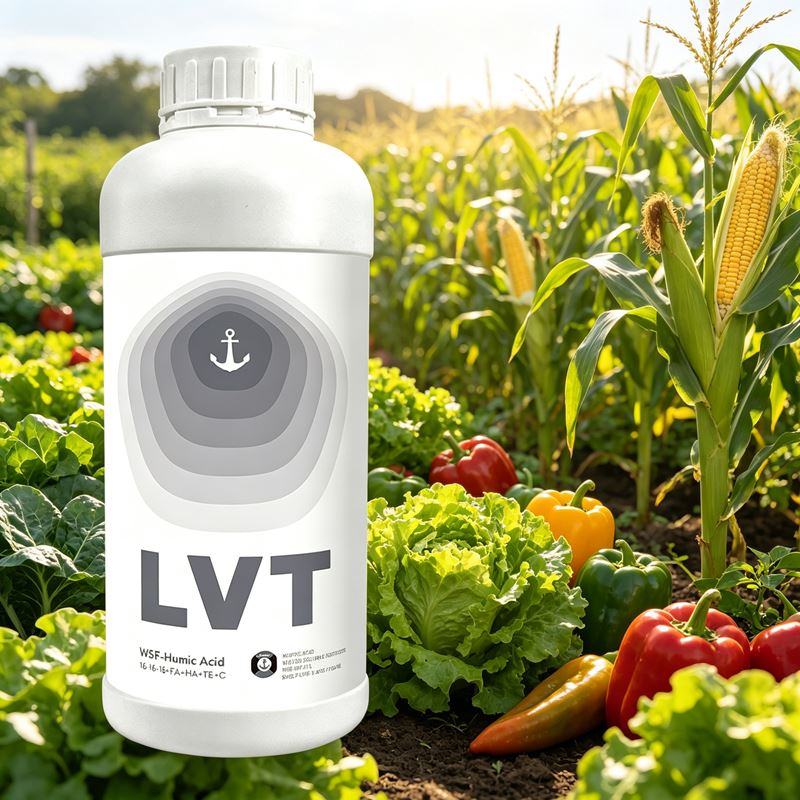


Balanced NPK 16-16-16 Humic Acid Suspension Fertilizer
1. Introduction
A balanced foliar feed is useful when the crop manager wants one pass to cover several nutritional priorities without pushing the program sharply toward nitrogen, phosphorus, or potassium. That situation often occurs during active canopy construction, after the crop has established, or between more stage-specific fertilizer applications.
LVT Balanced NPK 16-16-16 Humic Acid Fertilizer supplies nitrogen, phosphorus pentoxide, and potassium oxide at equal declared concentrations of 160 g/L. The mineral nutrients sit within a broader brown suspension containing humic acid, fulvic acid, amino acids, organic matter, carbon, and total trace elements.
The concentrate has a density of 1.46 g/mL and a pH of 6.0 ± 0.5. Sugar alcohol chelation is the stated formulation technology. The confirmed use is whole-canopy foliar spraying after dilution at 500-800 times. This makes the product a general-purpose foliar input, not a substitute for every base fertilizer or a stage-specific correction for a diagnosed deficiency.
2. One Suspension, Complete Nutrition: How the 16-16-16 + Organic Layer Is Built
The formula is best understood as two complementary layers built into one suspension.
The balanced NPK backbone. The product delivers 160 g/L each of nitrogen, phosphorus (as P₂O₅) and potassium (as K₂O) - the "16-16-16" in the product name is the commercial shorthand for this equal balance. A balanced ratio is a general-purpose feeding profile: nitrogen drives vegetative growth and protein formation, phosphorus supports energy transfer, root development and fruiting, and potassium underpins water regulation, translocation and stress tolerance. Because the three are balanced, the product suits growth stages where a crop needs broad, steady nutrition rather than a single-element push.
The organic layer. On the same base the suspension carries humic acid (30 g/L), the higher-molecular-weight conditioning fraction; fulvic acid (25 g/L), the lower-molecular-weight, more mobile fraction; and amino acids (40 g/L), which supply an organic nitrogen fraction and peptide building blocks. Organic matter (140 g/L) and carbon (80 g/L) complete the organic load, and the trace elements (4.5 g/L) are chelated with sugar alcohols to stay available and compatible inside the suspension.
Why it matters to a buyer. One 1 L bottle replaces a balanced NPK plus a separate organic tonic, simplifying inventory, tank preparation and field decisions. That is the core value proposition of this product: complete nutrition and organic conditioning in a single suspension.
3. Technical Data & Specifications
| Parameter | Specification |
|---|---|
| Nitrogen (N) | ≥ 160 g/L |
| Phosphorus (P₂O₅) | ≥ 160 g/L |
| Potassium (K₂O) | ≥ 160 g/L |
| Fulvic Acid (FA) | ≥ 25 g/L |
| Humic Acid (HA) | ≥ 30 g/L |
| Amino Acids (AA) | ≥ 40 g/L |
| Organic Matter (OM) | ≥ 140 g/L |
| Carbon (C) | ≥ 80 g/L |
| Trace Elements (TE) | ≥ 4.5 g/L |
| Chelation | Sugar-alcohol chelated |
| Physical State | Light-brown suspension |
| pH Value | 6.0 ± 0.5 |
| Density | 1.46 g/mL |
| Packaging | 1 L bottle |
| Shelf Life | 3 years |
4. Humic, Fulvic and Amino Acids in One Tank: What the Organic Layer Contributes
The three organic fractions are often grouped together, but they play complementary rather than duplicate roles in a foliar program.
Humic acid (HA) is the conditioning fraction of the formula. It contributes to the organic load delivered onto the plant and is commonly associated with programs aimed at buffering and soil-building over time.
Fulvic acid (FA) is a lower-molecular-weight fraction that remains mobile in dilute solution. Because of that mobility it is frequently paired with foliar and root programs where even distribution over the canopy matters.
Amino acids (AA) are organic nitrogen compounds and peptide building blocks that take part in protein metabolism. They give the formula an organic nitrogen contribution in addition to the mineral nitrogen in the NPK backbone.
Organic matter and carbon make up the broader organic platform that distinguishes this product from a plain balanced NPK. The carbon and organic-matter load is what allows a grower to add an organic conditioning pass at the same time as feeding.
It is worth being clear about the role of any foliar product: these inputs support the crop's nutrition program, they do not replace root uptake, soil fertility or water management. Consistent results depend on the whole program and on field conditions.
5. Where a Balanced Organic NPK Fits: Crops, Stages and Programs
Because the ratio is balanced, the product fits a wide range of crops and programs:
- Leafy and solanaceous vegetables - lettuce, Chinese greens, tomato, pepper, eggplant - during active vegetative growth.
- Cucurbits and root vegetables where even, general feeding is preferred during the main growth window.
- Orchards and high-value field crops as a maintenance-type foliar feed between specialty stages.
It is best used as the balanced base in a program that switches to targeted ratios at specific moments - for example, a flowering booster or a fruit-fill formula later in the season. Because it carries humic, fulvic and amino acids plus organic matter and carbon, it also suits growers who want to add an organic conditioning layer without buying a second product, and growers running soil-remediation or organic-input programs.
The recommended use is a whole-plant foliar spray at a 500–800× dilution, which fits standard spray schedules. Application stage, rate and frequency should be adjusted for the crop, its growth stage and local conditions - contact the LVT technical team for a crop-specific program.
6. A Light-Brown Suspension Built for Spray Equipment
This is a suspension, not a clear liquid, and the distinction matters in the field.
A suspension holds fine nutrient particles in liquid, which lets it carry a higher load per liter - the product's density is 1.46 g/mL - than a typical clear liquid of the same volume. The trade-off is that the particles need to be kept uniform. Shake the bottle well before use, and keep the tank gently agitated during spraying so the suspension stays evenly distributed from the first row to the last.
The pH of 6.0 ± 0.5 is near-neutral, which is gentle on spray equipment and generally compatible with standard foliar programs; as with any tank mix, a small jar test is always the safe first step. At a 500–800× dilution the product produces a fine mist suited to whole-plant coverage with backpack or boom sprayers. Rinse the tank, lines and nozzles after the job to keep equipment clean and ready for the next application.
7. Application Directions
| Application Method | Recommended Rate | Dilution Ratio | Notes |
|---|---|---|---|
| Whole-plant foliar spray | Dilute 1 part product with 500–800 parts water | 1:500 – 1:800 | Spray the full canopy; start at the higher dilution for young or sensitive stages and adjust after observation |
The recommendations above represent the most suitable application methods and rates for this product. If you plan to use a different fertilization method, please contact us for specific guidance.

Dilution Reference
| Water Volume | Product at 1:800 | Product at 1:500 |
|---|---|---|
| 15 L | 19 mL | 30 mL |
| 20 L | 25 mL | 40 mL |
| 100 L | 125 mL | 200 mL |
| 500 L | 0.63 L | 1 L |
| 1,000 L | 1.25 L | 2 L |
8. Mixing, Compatibility and Spraying Practice
Preparing the spray solution. Fill the tank with the required amount of water first, add the product while the tank is agitating, then top up to the final volume. Keep agitation running during application so the suspension stays uniform.
Tank mixing. Before combining with pesticides or other fertilizers, always run a small jar test: mix the products in the proportions you plan to use, wait, and check for flocculation, precipitation or separation. Avoid mixing with strongly alkaline products without first confirming compatibility.
Spray timing. Apply in early morning or late afternoon to reduce evaporation and improve leaf coverage. Avoid spraying in strong wind or immediately before heavy rain, which can wash the product off before it dries.
Coverage. Aim for even coverage of the whole canopy, including the undersides of leaves where practical, so the fine mist reaches the parts of the plant that drive growth.
Equipment care. Keep nozzles and filters clean, and rinse the tank and lines after the job. Clean equipment protects both the next application and the sprayer itself.
9. Storage, Shelf Life and Supply Support
Storage. Keep the bottle sealed in a cool, dry place away from direct sunlight, and protect it from freezing. Because it is a suspension, always shake the bottle well before each use. Keep out of the reach of children and away from food and animal feed.
Shelf life. The product carries a 3-year shelf life from production when stored correctly, which makes it practical for importers and distributors who plan inventory across seasons.
Supply support. Beyond the product itself, LVT provides the services that make an export or distribution program run smoothly: product samples, technical data and COA, MSDS, OEM and private-label packaging, custom formulation, full export documentation and registration support. Tell us your market and your program, and we will build the supply package around it.
10. FAQ
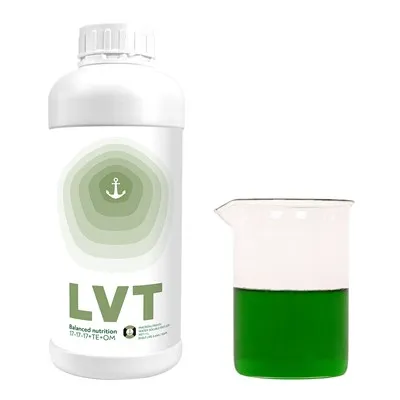
1. How is this 16-16-16 suspension different from a clear balanced NPK such as 17-17-17? The clear 17-17-17 concentrates on NPK plus trace elements. This product adds an organic layer - humic acid, fulvic acid, amino acids, organic matter and carbon - on top of the balanced NPK, so one application provides both macronutrient feeding and organic conditioning. Choose this product when the program also needs an organic input without a second bottle.
2. Why does one product contain humic acid, fulvic acid and amino acids at the same time? The three fractions are complementary. Humic acid is the conditioning fraction, fulvic acid is a more mobile lower-molecular-weight fraction, and amino acids supply an organic nitrogen contribution and peptide building blocks. Together with the organic matter and carbon they form the organic platform of the formula.
3. Is it really a suspension, and what should I do differently when spraying? Yes. The product is a light-brown suspension with a density of 1.46 g/mL. Shake the bottle well before use and keep the tank gently agitated during application so the suspension stays uniform. At a 500–800× dilution it produces a fine mist suited to whole-plant coverage.
4. Can I use it through drip irrigation or fertigation? The confirmed use for this product is whole-plant foliar spray at 500–800× dilution. If you plan to apply it through drip or other irrigation systems, please contact our technical team for specific guidance before use.
5. Can I tank-mix it with pesticides or other fertilizers? In most cases yes, but always run a small jar test first to check physical compatibility. Avoid mixing with strongly alkaline products without confirming compatibility, and keep the tank agitated during application.
6. What documentation and supply options are available for export buyers? LVT supplies product samples, technical data and COA, MSDS, OEM and private-label packaging, custom formulation, full export documents and registration support. Contact us with your market and program to build a supply package.
Contact WEIFANG LVWEITE BIO-TECH CO., LTD. for:
- Product samples
- Technical data and COA
- MSDS
- OEM packaging
- Private-label production
- Export quotations
- Registration support
Hot Tags: balanced npk 16-16-16 humic acid fertilizer | lvt, China balanced npk 16-16-16 humic acid fertilizer | lvt manufacturers, suppliers, factory