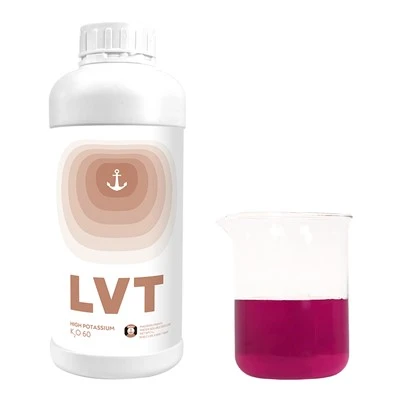


Root-Zone Support Humic Fulvic Powder Fertilizer
1. Introduction
A weak canopy does not always begin in the leaves. When plants lose vigor, wilt despite wet soil, or develop uneven color across a bed, the cause may be below ground. Compacted soil, restricted drainage, excess irrigation, salinity, fertilizer concentration, damaged roots, and soilborne pathogens can produce similar above-ground symptoms. Applying a product before checking the field conditions can hide the pattern without addressing the cause.
LVT Root-Zone Support Humic Fulvic Powder Fertilizer is a concentrated powder for use within a broader root-zone management program. Its composition is led by 20% humic acid, 15% fulvic acid, 25% Chinese herbal extracts, and 4.65% magnesium. Iron, zinc, manganese, boron, copper, molybdenum, and cobalt complete the declared mineral profile.
The product has a pH of 8.0 +/- 0.5 and is packed in a 2 kg bag. Four application routes are confirmed: drip irrigation, flush irrigation, sprinkler irrigation, and foliar spraying. The route should be selected after reviewing the irrigation system, crop stage, soil moisture, and the distribution of symptoms in the field.
2. Diagnose the Field Pattern Before Applying
The first decision is not how much product to use. It is where to look.
If the problem follows wet areas
Symptoms that are strongest in low spots, near leaking valves, or at the ends of poorly drained beds point toward water movement and root-zone oxygen as priorities. Correcting irrigation duration, drainage, or emitter uniformity may be more important than adding another input.
If the problem follows fertilizer placement
Damage beside injection points, fertilizer bands, or recently treated rows may indicate local salt concentration or mixing error. Review electrical conductivity, injection time, and the amount of clean water used to finish the irrigation cycle.
If individual plants fail inside otherwise uniform rows
Scattered collapse can justify root inspection and diagnostic testing. Lift representative plants, compare fine-root condition, and keep damaged material away from healthy blocks until the cause is better understood.
If the whole block loses color gradually
A block-wide trend may be connected to nutrient availability, root temperature, irrigation-water quality, or a systemic management issue. Soil, water, and tissue results are more useful than symptom color alone.
This product supplies organic fractions, magnesium, and trace elements. It is not a substitute for drainage repair, sanitation, laboratory diagnosis, or a registered crop-protection treatment when a pathogen has been confirmed.
3. Technical Data & Specifications
| Parameter | Confirmed Specification |
|---|---|
| Fulvic Acid (FA) | 15% |
| Humic Acid (HA) | 20% |
| Magnesium (Mg) | 4.65% |
| Iron (Fe) | 0.40% |
| Zinc (Zn) | 0.49% |
| Manganese (Mn) | 0.20% |
| Boron (B) | 0.20% |
| Copper (Cu) | 0.05% |
| Molybdenum (Mo) | 0.01% |
| Cobalt (Co) | 0.01% |
| Chinese Herbal Extracts | 25% |
| Formulation | Water-soluble powder |
| Appearance | Gray-brown fine powder with occasional pale granules |
| pH | 8.0 +/- 0.5 |
| Standard Package | 2 kg bag |
| Confirmed Application Routes | Drip irrigation, flush irrigation, sprinkler irrigation, and foliar spraying |
4. What the Formula Contributes
Humic and fulvic fractions
Humic acid and fulvic acid account for 35% of the formula. In field planning, these components are best considered alongside soil organic matter, irrigation-water chemistry, and the physical condition of the root zone. Their presence does not remove the need to correct compaction, standing water, or an unsuitable irrigation schedule.
Magnesium as the main declared mineral nutrient
Magnesium is supplied at 4.65%, a much higher concentration than any individual trace element in the formula. Because magnesium also appears in many base fertilizers, foliar feeds, and irrigation-water sources, the total program should be reviewed before repeated use.
A measured trace-element package
Zinc and iron are present at 0.49% and 0.40%. Manganese and boron are each supplied at 0.20%, followed by copper at 0.05% and molybdenum and cobalt at 0.01% each. These are declared ingredients, not a license to apply the powder without regard to soil status or overlapping micronutrient products.
Chinese herbal extracts
Chinese herbal extracts make up 25% of the formulation. This is a confirmed composition feature. The specification does not establish a pesticidal mode of action, pathogen-control percentage, or guaranteed disease-recovery result, so the product should be presented as a root-zone nutrition and management input.
5. Build the Program Around the Cause
A useful root-zone program connects the product to actions that can be checked in the field.
Water and air in the root zone
Record irrigation duration, emitter output, drainage time, and soil moisture at more than one depth. When water remains around roots for too long, shortening the interval between fertilizer applications will not solve the oxygen problem.
Root inspection and hygiene
Examine roots from healthy, intermediate, and severely affected plants. Use clean tools between areas, remove heavily damaged material according to local practice, and avoid moving wet soil from affected rows into clean blocks.
Nutrition without stacking inputs
Count magnesium, boron, zinc, iron, manganese, copper, molybdenum, and cobalt already supplied through the base fertilizer, foliar program, and other specialty products. This formula is broad enough that overlap can occur even when each individual application appears modest.
Follow-up using fixed observation points
Mark plants or beds before application. Photograph the same positions, note new root growth and canopy behavior, and keep irrigation settings unchanged during the observation window when practical. This makes it easier to separate product response from weather or irrigation changes.
6. Choose the Delivery Route
Drip irrigation for targeted root-zone placement
Drip irrigation is appropriate where the system has reliable filtration and uniform emitter output. Pre-dissolve the powder, remove undissolved particles, and inject during the middle portion of the irrigation cycle so the solution can move through the active root area.
Flush irrigation for broader bed or furrow distribution
Flush irrigation uses a higher rate per mu and depends heavily on water distribution. The diluted product should move evenly across the intended area rather than collect at the inlet or in low spots.
Sprinkler irrigation for wide-area delivery
Sprinkler application uses the lowest confirmed field rate per mu. It requires complete dissolution and suitable filtration to protect pumps and nozzles. Wind, evaporation, and overlapping sprinkler patterns can change field uniformity.
Foliar spraying when root delivery is not the only objective
Foliar spraying provides a separate delivery path for magnesium and trace elements. It does not directly correct saturated soil, blocked drip lines, or damaged roots. Spray both leaf surfaces evenly at 600-800x dilution and avoid excessive runoff.
7. Application Directions
| Application Method | Recommended Rate | Preparation and Application | Approximate Coverage per 2 kg Bag |
|---|---|---|---|
| Drip irrigation | 3.04 kg/acre | Pre-dissolve and filter the product before injecting it into a functioning drip-irrigation system. | 0.66 acre |
| Flush irrigation | 6.07 kg/acre | Dilute with sufficient water and distribute evenly throughout the target root zone. | 0.33 acre |
| Sprinkler irrigation | 607 g/acre | Dissolve completely and filter before introducing the solution into the sprinkler system. | 3.30 acres |
| Foliar spraying | Dilute 1:600–800 | Apply evenly to the upper and lower leaf surfaces without excessive runoff. | Approximately 6.59 acres while maintaining the specified dilution |
The recommendations above represent the most suitable application methods and rates for this product. If you plan to use a different fertilization method, please contact us for specific guidance.
8. Prepare the Powder for Irrigation and Spray Equipment
Powder handling determines whether the selected rate reaches the field uniformly.
- Confirm the final water volume, treated area, and selected application route.
- Use a clean premix container and water that does not contain visible sediment.
- Add the measured powder slowly to water while stirring. Do not load dry powder directly into filters, injectors, or irrigation mains.
- Continue mixing until the solution is uniform, then pass it through a screen suitable for the equipment.
- Half-fill the main tank with water before adding the filtered premix.
- Maintain circulation or agitation during application where the equipment allows.
- For drip or sprinkler use, finish with clean water to move the solution into the target zone and rinse the lines.
- Clean measuring tools, screens, filters, tanks, and nozzles after the work is complete.
Before combining the product with another fertilizer or crop-protection material, prepare a small jar test using the actual water source. Stop if the mixture forms persistent sediment, gel, heavy foam, separation, or unusual heat. Physical compatibility does not confirm crop safety, so a small-area field test remains appropriate for an unfamiliar combination.

9. Verification, Storage, and Supply
A field record that answers useful questions
Record the treated block, crop stage, application route, rate, water volume, irrigation duration, weather, and any other materials in the tank. Recheck the same marked plants rather than selecting different examples after treatment. Useful observations include new fine-root development, canopy turgor, new-leaf color, survival of growing points, and whether decline continues to spread into adjacent plants.
Avoid describing a result as disease control unless the original cause was diagnosed and the claim is supported by the registration and evidence required in the destination market.
Storage of the 2 kg powder bag
Keep the bag sealed in a cool, dry, ventilated place. Protect the powder from rain, condensation, direct contact with damp floors, and prolonged heat. Close a partially used bag promptly and keep it separate from food, feed, and unauthorized users.
Export and private-label preparation
The confirmed standard unit is a 2 kg bag. OEM projects can discuss label language, outer-carton configuration, palletization, technical specifications, COA, MSDS, and registration-document support. Claims relating to microbial content, disease control, or pesticide activity require separate confirmation before they appear on labels or sales materials.
10. FAQ
1. Is this product a fungicide for root rot?
No. The supplied specification describes a powder containing humic acid, fulvic acid, magnesium, trace elements, and Chinese herbal extracts. It does not provide a fungicide active ingredient, pesticide registration, or verified pathogen-control claim.
2. Does the formula contain microbial inoculants?
No microbial species or viable-count guarantee has been supplied for this version. A microbial claim should only be published when the strain identity, viable count, test method, and applicable registration documents are confirmed.
3. Which application route should be used first?
Choose according to the field cause and the equipment. Drip or flush irrigation places the solution in the root zone, sprinkler irrigation covers a wider area, and foliar spraying supplies nutrients through the canopy. None of these routes corrects poor drainage by itself.
4. How much area does one 2 kg bag cover?
At the confirmed field rates, one bag covers 4 mu by drip irrigation, 2 mu by flush irrigation, or 20 mu by sprinkler irrigation. The supplied foliar reference is 40 mu while maintaining a 600-800x dilution.
5. Can the powder be poured directly into a drip tank?
Pre-dissolve and filter it first. A premix reduces localized concentration and helps protect injectors, filters, emitters, and sprinkler nozzles from undissolved particles.
6. Can it be mixed with other fertilizers or crop-protection products?
Compatibility depends on water quality, formulation, concentration, and mixing order. Dilute materials separately, complete a jar test, and perform a small-area crop-safety check before preparing a full tank.
Contact WEIFANG LVWEITE BIO-TECH CO., LTD. for:
- Product samples
- Technical data and COA
- MSDS
- OEM packaging
- Private-label production
- Export quotations
- Registration support
Hot Tags: root-zone support humic fulvic powder fertilizer | lvt, China root-zone support humic fulvic powder fertilizer | lvt manufacturers, suppliers, factory