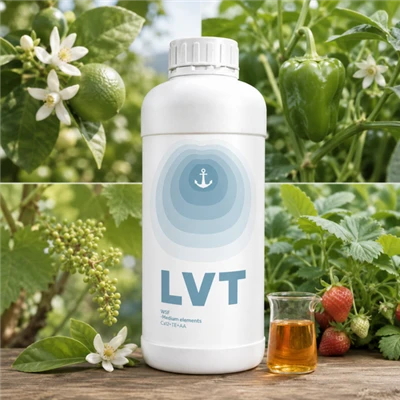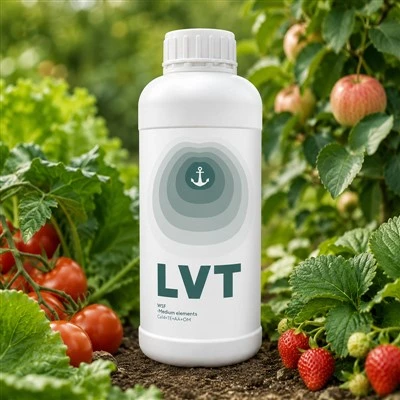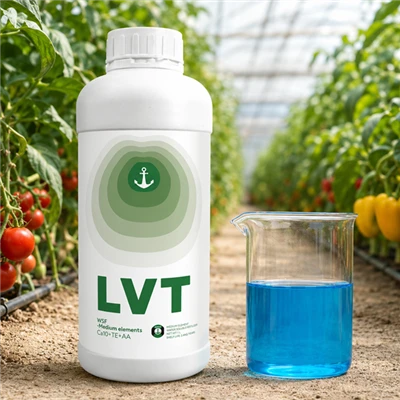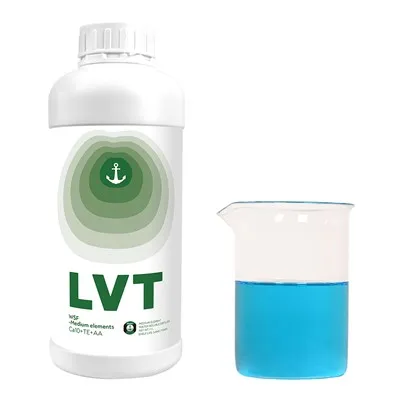


Sugar Alcohol Chelated Calcium Boron Magnesium Liquid Fertilizer
1. Introduction
Some foliar products are built for routine maintenance. This one has a more specific place in the crop calendar. Calcium is the main declared secondary nutrient at 100 g/L, while boron is supplied at a comparatively substantial 20 g/L. Magnesium, nitrogen, amino acids and organic matter complete a formula intended for carefully timed canopy applications rather than repeated, unscheduled spraying.
The product is a deep green clear liquid with a density of 1.42 g/mL and a near-neutral pH of 7.5 ± 0.5. Sugar alcohol chelation is the confirmed complexing technology. After dilution at 600–1,000 times, the spray is applied across the whole canopy, including actively growing leaves, flower-bearing shoots and accessible young fruit surfaces.
Because boron tolerance varies considerably among crops, the final concentration and application interval should be decided from crop stage, previous boron inputs, local label requirements and a small-area trial.
2. A Focused Formula, Not a Routine Calcium Spray
The 10:2:1 relationship between calcium, boron and magnesium gives the product a clear identity. It is not simply a calcium feed with token trace nutrients, and it should not be selected only because a buyer wants a higher calcium number.
At 20 g/L, boron materially affects how the product should be used. A well-timed application may fit a program approaching flowering, fruit set or early fruit development, but the same concentration may be unnecessary where boron has already been supplied through soil fertilizer, fertigation or another foliar pass.
Nitrogen is also significant at 90 g/L. This makes the formula different from a low-nitrogen reproductive-stage micronutrient product. Growers should count that nitrogen contribution when deciding whether the spray fits late-season management or crops already showing strong vegetative growth.
The practical selection question is therefore not "Does the crop need calcium?" but "Does the crop program need calcium, boron and magnesium together, with added nitrogen and organic components, at this particular stage?"
3. Technical Data & Specifications
| Item | Specification |
|---|---|
| Calcium (Ca) | ≥100 g/L |
| Boron (B) | ≥20 g/L |
| Magnesium (Mg) | ≥10 g/L |
| Amino Acids (AA) | ≥60 g/L |
| Organic Matter | ≥90 g/L |
| Nitrogen (N) | ≥90 g/L |
| Phosphorus Pentoxide (P₂O₅) | ≥10 g/L |
| Copper (Cu) | ≥0.2 g/L |
| Iron (Fe) | ≥0.2 g/L |
| Chelation Technology | Sugar alcohol chelation |
| Formulation | Concentrated clear liquid |
| Appearance | Deep green clear liquid |
| Density | 1.42 g/mL |
| pH | 7.5 ± 0.5 |
| Standard Package | 1 L bottle |
| Confirmed Application Method | Whole-canopy foliar spraying |

4. What the Supporting Matrix Adds
Sugar alcohol chelation
Sugar alcohol chelation is used as the stated complexing approach for the mineral portion of the formula. It distinguishes this version from the amino-acid-chelated calcium–magnesium product elsewhere in the range. It should be described as a formulation feature, not as proof of a fixed absorption rate or transport percentage.
Amino acids and organic matter
Amino acids are declared at 60 g/L and organic matter at 90 g/L. Together they create a broader formulation than a basic mineral salt solution. Their presence does not, on its own, establish organic-farming certification or compatibility with every crop-input standard.
Nitrogen and low-level phosphorus
Nitrogen at 90 g/L is part of the working nutrient load, while phosphorus pentoxide is present at 10 g/L. Both should be included when reviewing the complete spray schedule, especially if the tank or weekly program contains another NPK product.
Copper and iron
Copper and iron are each supplied at 0.2 g/L. They are supporting trace elements rather than the product's main selection criteria. Avoid building disease-control or rapid-greening claims around these low declared concentrations without product-specific field evidence.
5. Timing the Spray Around Crop Development
Before flowering
Where tissue analysis and field history support a combined Ca–B–Mg input, the product may be considered as the crop moves from canopy building toward reproductive development. Crops that are sensitive to boron should begin at 1:1,000 and receive a small-area test.
Flowering and fruit set
Application may fit selected orchard, vine, berry and fruiting-vegetable programs during flowering or early set. Avoid spraying open flowers in hot, drying conditions, and do not assume that a foliar nutrient can compensate for poor pollination weather, water stress or root-zone imbalance.
Early fruit development
The formula may remain relevant while young fruit and the surrounding canopy are actively developing. Later in the season, reassess whether the 90 g/L nitrogen and 20 g/L boron still suit the crop objective. A lower-nitrogen or differently balanced formula may be more appropriate as ripening approaches.
The product should be scheduled from actual crop development rather than a fixed calendar date.
Discuss a Crop-Stage Spray Plan
6. Match the Crop Before Choosing the Rate
Perennial fruit and vine crops
Apple, pear, citrus, grape, peach and other commercially managed fruit crops may use a carefully timed application when a combined calcium–boron–magnesium foliar input is justified. Variety, flowering status, recent boron use and local growing conditions should guide the rate.
Fruiting vegetables
Tomato, pepper, eggplant, cucumber, melon and watermelon can be considered during the transition from vegetative growth to flowering and early fruit development. The product should not be promoted as a guaranteed solution for blossom-end rot, fruit cracking or flower loss because irrigation, salinity, temperature, root health and pollination can also influence these problems.
Berries and protected crops
Strawberry and other intensively managed berry crops often receive several foliar inputs within a short period. Check the cumulative boron and nitrogen load before adding this formula, particularly in greenhouse or substrate systems.
Flowers and nursery plants
Use on ornamentals and nursery crops should begin with a conservative dilution and a limited test area. Differences among species and cultivars can be substantial, especially when sprays contact flowers or tender new growth.
7. Application Directions
| Application Method | Recommended Dilution | Spray Target | Timing and Notes |
|---|---|---|---|
| Whole-canopy foliar spraying | 1:600–1,000 | Apply a fine, even mist to leaves, growing points, flower-bearing shoots and accessible young fruit surfaces without excessive runoff | Spray during the cooler part of the day. Use 1:1,000 for initial trials, young plants or sensitive crops; select a stronger concentration only after crop tolerance and total boron input have been reviewed. |
The recommendations above represent the most suitable application methods and rates for this product. If you plan to use a different fertilization method, please contact us for specific guidance.
Dilution Reference
| Final Water Volume | Product at 600× | Product at 1,000× |
|---|---|---|
| 15 L | 25 mL | 15 mL |
| 20 L | 33.3 mL | 20 mL |
| 100 L | 166.7 mL | 100 mL |
| 500 L | 833.3 mL | 500 mL |
| 1,000 L | 1.67 L | 1.00 L |
The dilution ratio describes the relationship between product volume and final water volume. Measure accurately; do not estimate the concentrate by bottle-cap volume.
8. Control the Water, Droplet Size and Tank Order
A successful foliar pass depends on more than the dilution number. Begin with clean water and a tank free of residues from previous pesticide or fertilizer applications. Half-fill the tank, start agitation, measure the product accurately and add it to the moving water. Complete the tank volume only after the concentrate has dispersed uniformly.
Use nozzles that produce fine, controlled droplets capable of covering both outer and inner foliage. Dense canopies are better handled by adjusting walking speed, pressure and spray direction than by increasing concentration. Stop before the solution runs from leaves or collects on flowers and fruit.
For a new tank mix, dilute each product separately and conduct a jar test using the actual spray water. Calcium-containing concentrates require particular care around phosphate- and sulfate-rich materials. Strongly alkaline products, oils, pesticides and plant growth regulators should also be checked before combined use.
Do not use a mixture that develops flakes, sediment, gel, separation, unusual heat or persistent excessive foam. Physical stability in a jar does not replace a crop-safety trial.
9. Buyer Checklist for the Clear-Liquid Version
The existing page name includes the word "suspension," but the latest confirmed product is a deep green clear liquid. Quotations, specifications, labels and new website copy should follow the current physical description and should not reuse claims about anti-sedimentation agents or suspension stability.
Buyers comparing this formula with other LVT medium-element products should confirm four points:
- Chelation technology: sugar alcohol chelation, not amino acid chelation.
- Nutrient emphasis: calcium at 100 g/L with boron at 20 g/L and magnesium at 10 g/L.
- Supporting composition: nitrogen, amino acids, organic matter, low phosphorus, copper and iron are included.
- Confirmed use: whole-canopy foliar spraying at 600–1,000×; fertigation and root-drench rates have not been confirmed for this version.
The standard package is a 1 L bottle. Keep the container tightly closed and protected from direct sunlight, freezing and prolonged high temperature. Before dispatch or registration, the approved COA and label should be checked against the destination market's rules for nutrient declarations and product naming.
10. FAQ
1. Is this product a suspension fertilizer?
No. The current specification describes a deep green clear liquid. The old URL may remain for continuity, but the revised product description should not call it a suspension.
2. Why does the boron concentration affect application planning?
Boron is declared at 20 g/L and crop tolerance varies. Review previous soil, fertigation and foliar boron inputs before choosing the concentration or repeating an application.
3. Which dilution is suitable for a first crop trial?
Begin at 1:1,000 on a limited area. Observe spray compatibility and crop response before treating the full block or moving toward 1:600.
4. Can it be used through fertigation or root drenching?
Only whole-canopy foliar spraying has been confirmed for this version. Contact the technical team before adopting a different delivery method.
5. Can it be mixed with phosphate or sulfate fertilizers?
Do not combine concentrated products directly. Dilute materials separately and complete a jar test with the intended water source because calcium may form insoluble compounds with concentrated phosphate or sulfate inputs.
6. Do the values in g/L equal percentage by weight?
No direct conversion should be assumed. The declared values are mass per liter of product. Any percentage-by-weight statement must use the correct analytical basis and confirmed product density.
Contact WEIFANG LVWEITE BIO-TECH CO., LTD. for:
- Product samples
- Technical data and COA
- MSDS
- OEM packaging
- Private-label production
- Export quotations
- Registration support
Hot Tags: sugar alcohol chelated ca b mg fertilizer | lvt, China sugar alcohol chelated ca b mg fertilizer | lvt manufacturers, suppliers, factory