Sugar Alcohol Chelated Calcium Magnesium Zinc Boron Liquid Fertilizer
1. Introduction
A foliar program does not always need another broad NPK input. In orchards, vines and fruiting vegetables, the more immediate question may be whether several secondary and micronutrients need to be supplied together without adding a large phosphorus dose.
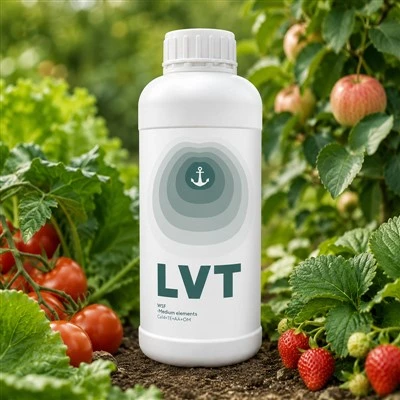
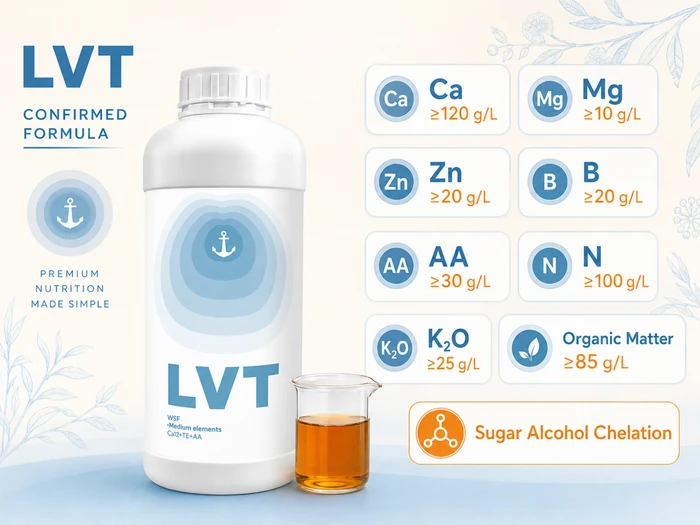
LVT Sugar Alcohol Chelated Calcium Magnesium Zinc Boron Liquid Fertilizer is built for that narrower task. The formula is led by 120 g/L calcium and contains equal declared concentrations of zinc and boron at 20 g/L each, plus 10 g/L magnesium. Nitrogen, potassium, amino acids and organic matter provide the supporting matrix.
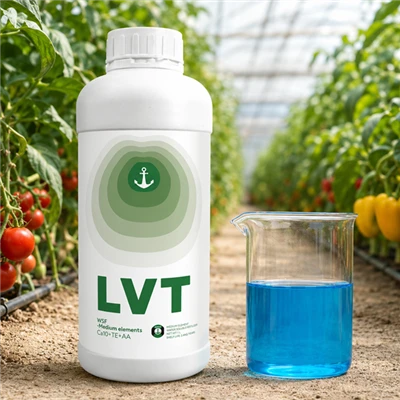
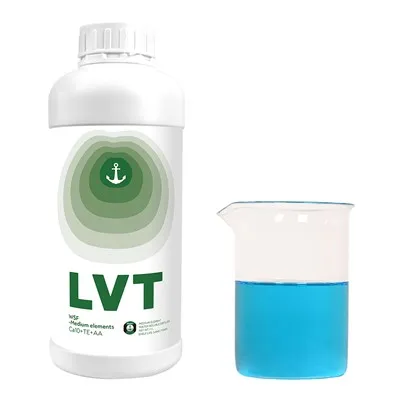
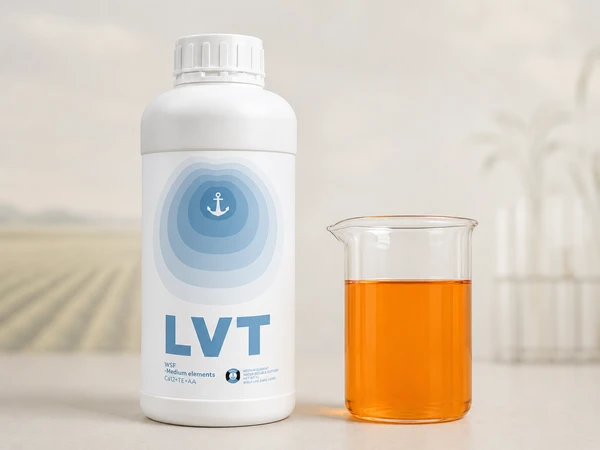
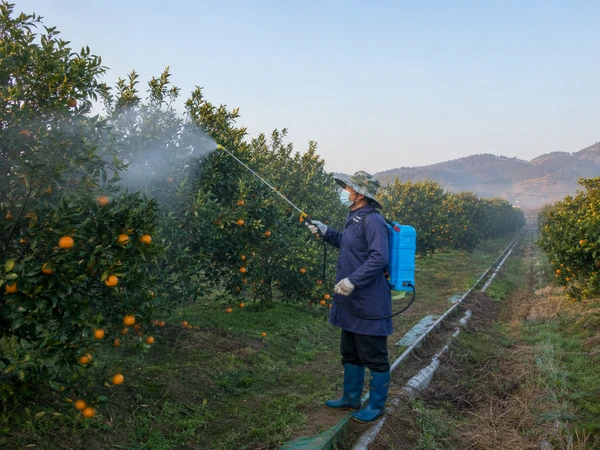
The product is an orange clear liquid rather than a suspension. It is supplied in a 1 L bottle and intended for whole-canopy foliar spraying after dilution at 600–1,000 times. Its role is supplemental: it should be inserted into an existing nutrition program after considering crop stage, tissue demand and every other fertilizer used in the same period.
2. Why This Formula Is Not a Standard Calcium Feed
The formula should not be evaluated only by its calcium concentration. Zinc and boron are each present at 20 g/L, so the product carries a much stronger trace-element contribution than a conventional calcium–magnesium foliar feed. That changes both its most appropriate use and the care required when setting application frequency.
The declared 100 g/L nitrogen and 25 g/L potassium oxide also make it different from a trace-element-only correction product. These nutrients contribute to the total foliar load and should be counted when the crop already receives nitrogen- or potassium-containing sprays.
This combination is best treated as a planned multi-element application. It is not a universal replacement for separate calcium, magnesium, zinc or boron products, and it should not be applied repeatedly without reviewing the full crop program.
3. Technical Data & Specifications
| Item | Specification |
|---|---|
| Calcium (Ca) | ≥120 g/L |
| Magnesium (Mg) | ≥10 g/L |
| Zinc (Zn) | ≥20 g/L |
| Boron (B) | ≥20 g/L |
| Amino Acids (AA) | ≥30 g/L |
| Nitrogen (N) | ≥100 g/L |
| Potassium Oxide (K₂O) | ≥25 g/L |
| Organic Matter | ≥85 g/L |
| Chelation Technology | Sugar alcohol chelation |
| Formulation | Concentrated clear liquid |
| Appearance | Orange clear liquid |
| Density | 1.56 g/mL |
| pH | 7.0 ± 0.5 |
| Standard Package | 1 L bottle |
| Confirmed Application Method | Whole-canopy foliar spraying |
4. Sugar Alcohol Chelation and Formula Behavior
Sugar alcohol chelation is the confirmed chelation technology for this product. Within the formulation, it provides an organic complexing approach for the calcium, magnesium and trace-element package. This is a formulation characteristic; it should not be presented as proof of a particular absorption percentage or transport rate unless supported by product-specific trial data.
The clear-liquid form has practical value during measuring and tank preparation because there is no suspension sediment to redisperse. Even so, the concentrate should be mixed into water rather than combined directly with another concentrated fertilizer.
The near-neutral pH of 7.0 ± 0.5 describes the product itself. Final tank pH can change with water quality and other inputs, so growers should judge compatibility using the actual spray water and intended mixture.
Discuss a Multi-Element Foliar Formula
5. Four Nutrient Jobs Across One Application Window
Calcium: developing tissues
Calcium is the dominant declared secondary nutrient. It is relevant when the crop is producing new leaves, flowers or young fruit, but foliar calcium remains only one part of calcium management. Root-zone supply, irrigation and transpiration conditions still influence crop calcium status.
Magnesium: the supporting secondary element
Magnesium is supplied at 10 g/L. It complements the formula where a modest magnesium contribution is useful, but the product is not positioned as a high-magnesium corrective treatment.
Zinc: growth and enzyme-related demand
Zinc participates in numerous plant enzyme systems and growth processes. At 20 g/L, it is a substantial part of this formula rather than a token trace addition. Existing zinc inputs should be reviewed before repeated applications.
Boron: reproductive-stage relevance with a narrow margin
Boron is associated with growing and reproductive tissues. Because the declared concentration is also 20 g/L, crop sensitivity, local label requirements and overlapping boron products deserve particular attention. More frequent application is not automatically better.
6. Crop Selection by Production Objective
Orchard and vine programs
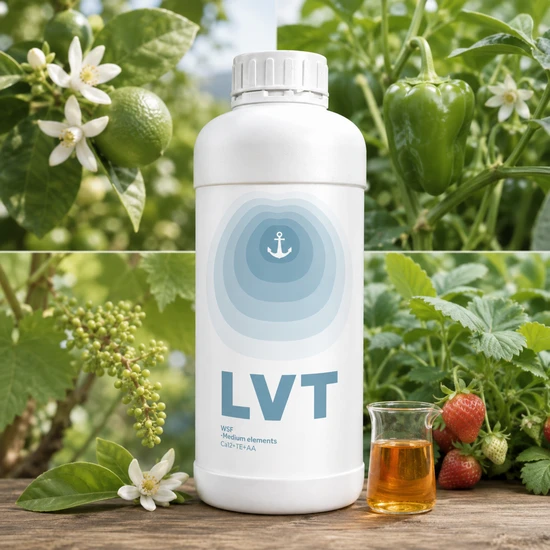
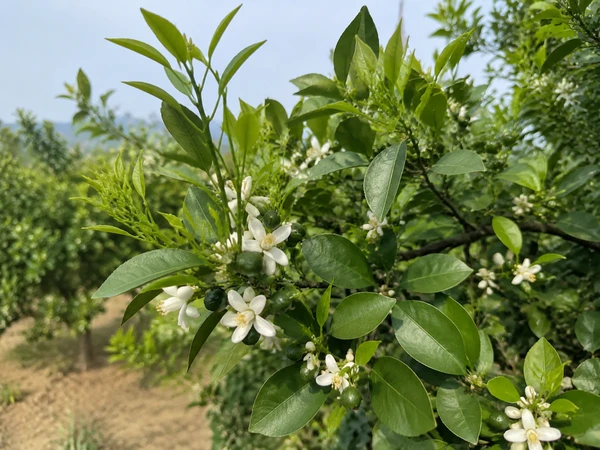
Citrus, apple, pear and grape programs may consider the product around new flush, pre-bloom, flowering or early fruit development when a combined Ca–Mg–Zn–B foliar input is justified. Stage selection should reflect local tissue analysis and the rest of the orchard spray schedule.
Fruiting vegetables
Tomato, pepper, cucumber, eggplant, melon and watermelon may use a carefully timed application during active canopy development or the transition into reproductive growth. Avoid assuming that the formula alone will prevent cracking, blossom-end rot or fruit abortion.
Berries, flowers and nursery crops
Strawberry, selected berry crops, flowering ornamentals and nursery plants can be sensitive to concentration and water quality. Begin at the more dilute end of the range and complete a small-area test.
Field and specialty crops
Use on field crops should be based on a confirmed combined nutrient requirement rather than routine calendar spraying. This is particularly important where boron or zinc has already been applied through seed treatment, soil fertilizer or an earlier foliar pass.
7. Application Directions
| Application Method | Dilution Ratio | Spray Target | Timing and Notes |
| Whole-canopy foliar spraying | 1:600–1,000 | Wet leaves, growing points, flower-bearing shoots and accessible developing fruit surfaces evenly without excessive runoff | Apply during the cooler part of the day. Select the final concentration according to crop sensitivity, growth stage, water quality and other nutrient inputs. |
The recommendations above represent the most suitable application methods and rates for this product. If you plan to use a different fertilization method, please contact us for specific guidance.
Dilution Reference
| Final Water Volume | Product at 600× | Product at 1,000× |
| 15 L | 25 mL | 15 mL |
| 20 L | 33.3 mL | 20 mL |
| 100 L | 166.7 mL | 100 mL |
| 500 L | 833.3 mL | 500 mL |
| 1,000 L | 1.67 L | 1.00 L |
Use the 1:1,000 dilution for an initial crop-safety check. A 1:600 mixture contains more product per liter and should only be selected where crop tolerance and the nutrition plan support the stronger concentration.
8. Building a Reliable Foliar Pass
- Confirm the required spray-water volume before measuring the product.
- Start with a clean tank and a known water source.
- Fill the tank halfway with water and begin agitation.
- Measure the fertilizer according to the chosen dilution ratio.
- Pre-dilute it separately when preparing a complex tank mixture.
- Add it to the main tank, complete the water volume and maintain gentle agitation.
- Spray the complete canopy with fine, even droplets without allowing solution to pool on leaves or fruit.
- Rinse the tank, lance, nozzles and lines with clean water after use.
Avoid spraying hot, wilted or waterlogged crops. Do not apply in strong sunlight, high wind or immediately before rain. Where the canopy is dense, adjust walking speed and nozzle direction to improve coverage rather than increasing concentration without review.
9. Buyer Notes: Clear-Liquid Identity and Formula Selection
This product should be specified as an orange clear liquid. The existing URL and older description use the term "suspension fertilizer," but that wording does not match the latest confirmed physical form and should be removed from the revised page, specification sheet and quotation materials.
When comparing this formula with other LVT medium-element products, buyers should look beyond the calcium value. This version is distinguished by 20 g/L zinc, 20 g/L boron and sugar alcohol chelation. A calcium–magnesium product may be more appropriate where the buyer does not need those higher trace-element inputs.
The confirmed standard package is a 1 L bottle. OEM packaging, private-label presentation and registration documents should be discussed against the destination market's labeling and nutrient-declaration rules rather than assumed from the old page.
For storage, keep the bottle tightly closed in a cool, dry and ventilated location. Protect it from freezing, prolonged heat and direct sunlight. Keep it separated from food, feed and unauthorized users.
10. FAQ
1. How does this product differ from a calcium–magnesium foliar fertilizer?
It adds zinc and boron at 20 g/L each and uses sugar alcohol chelation. It is therefore a broader multi-element formula, not simply a higher-calcium version of another product.
2. Is this a suspension fertilizer?
No. The latest confirmed specification is an orange clear liquid. The revised page should use this description even though the old URL contains the word "suspension."
3. Does "Ca12+TE+AA" on the label represent the complete guaranteed analysis?
No. It is abbreviated packaging language. The complete confirmed analysis is the grams-per-liter specification shown in the technical table.
4. Can it be applied through fertigation or root drenching?
Only whole-canopy foliar spraying at 600–1,000× has been confirmed for this page. Contact LVT for specific guidance before adopting another delivery method.
5. What products require extra care in a tank mix?
Exercise particular caution with concentrated phosphate, sulfate and strongly alkaline materials. Dilute products separately and complete a jar test using the actual spray water before full-scale mixing.
6. Which dilution should be used for the first application?
Start at 1:1,000 on a small area, especially for young plants, sensitive varieties or crops with no previous exposure to the product. Review the crop response before treating the complete area or moving toward 1:600.
Contact WEIFANG LVWEITE BIO-TECH CO., LTD. for:
- Product samples
- Technical data and COA
- MSDS
- OEM packaging
- Private-label production
- Export quotations
- Registration support
Hot Tags: sugar alcohol chelated ca mg zn b fertilizer | lvt, China sugar alcohol chelated ca mg zn b fertilizer | lvt manufacturers, suppliers, factory